


The 2025–26 MVP race was supposed to be simple. It was lining up as a heavyweight duel between Nikola Jokic and Shai Gilgeous-Alexander, the league’s most efficient offensive engine versus its most lethal scoring guard on the West’s best team. Instead, the conversation has shifted from dominance to availability.
Because of the NBA’s 65-game eligibility rule, instituted in the 2023 CBA to curb load management, performance alone is no longer enough. To qualify for MVP, a player must appear in at least 65 games and log 20+ minutes in at least 63 of them. Miss 18 games, and the case is over. No exceptions for brilliance.
Suddenly, the race is less about who is best, and more about who is still standing.
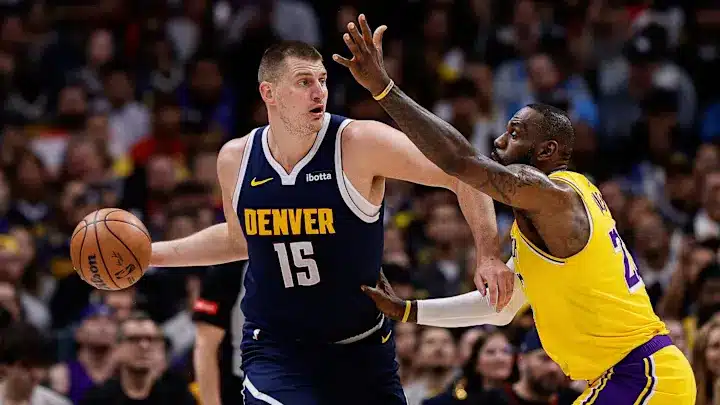
Nikola Jokic is Having One Of The Best Seasons Ever
The three-time MVP suffered a hyperextended left knee with a bone bruise on December 29 against Miami. It sidelined him for 16 games, the longest absence of his career. He returned in late January and has been active since, but the math is unforgiving. With 16 games already missed, he can afford just one more absence the rest of the season. One. Any additional DNP, injury management, rest, minor flare-up, would drop him below 65.
That razor-thin margin fundamentally alters his candidacy.
Statistically, Jokic remains extraordinary. He is averaging roughly 28.8 points, 12.6 rebounds, and 10.5 assists on elite efficiency near 57 percent from the field and 40 percent from three. His advanced metrics remain dominant. By impact models, he is still arguably the most valuable offensive player alive. But the Nuggets hovering around the middle of the Western playoff picture weakens the narrative, and the eligibility risk looms over everything. Voters may hesitate to invest in a candidate one minor setback away from disqualification.
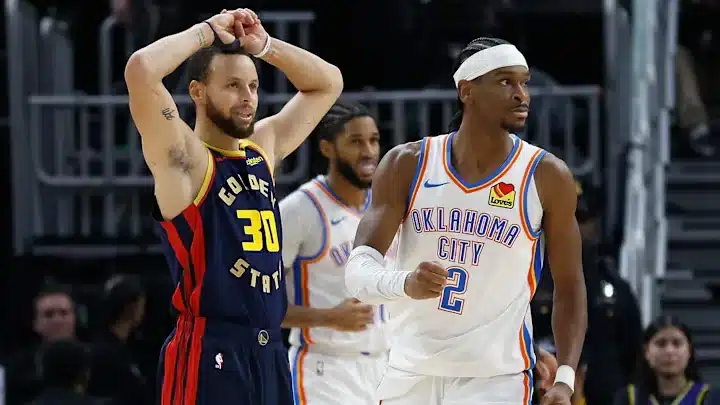
Shai Gilgeous Alexander Is The Next Player
SGA’s injury, a recurring abdominal strain, has not been as prolonged as Jokic’s knee issue, but it has required management. He has missed roughly 10 to 11 games and has been selectively ruled out in recent weeks. The Thunder, meanwhile, own one of the league’s best records, strengthening his case considerably.
The key difference: flexibility.
SGA can still miss several more games and remain eligible. That buffer keeps him in the driver’s seat. And his production supports it. He is averaging around 31.8 points per game on 55 percent shooting, plus over six assists, while anchoring a top-tier team. His efficiency, late-game scoring, and two-way pressure all reinforce the MVP narrative.
If both players reach 65 games, the debate remains classic: Jokic’s all-encompassing efficiency versus SGA’s scoring volume and team dominance.
But if one, or both, fall short, the landscape shifts dramatically.
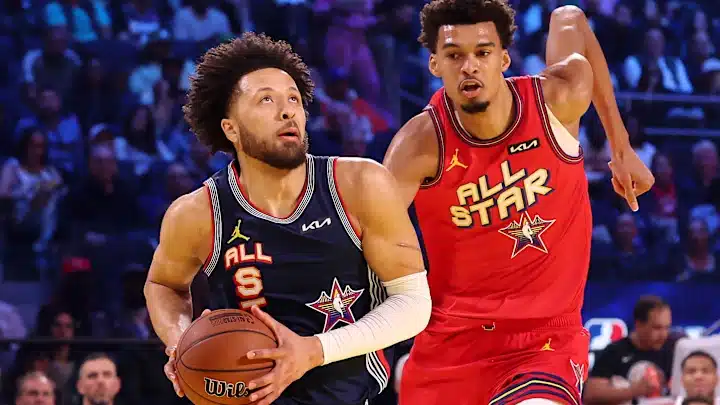
Cade Cunningham Or Victor Wembanyama?
Cunningham has surged into legitimate MVP contention. He is averaging roughly 25.5 points and 9.8 assists per game, ranking near the top of the league in playmaking volume while carrying Detroit’s offense. His statistical profile blends scoring and orchestration at an elite level, and the Pistons’ rise in competitiveness strengthens the optics. Advanced metrics support him as one of the league’s most impactful guards, and his late-season surge has amplified momentum.
In a field suddenly defined by availability, Cunningham becomes the most complete remaining résumé: elite counting stats, high usage, team improvement, and durability.
Close behind is Victor Wembanyama.
Wembanyama’s MVP case rests on two-way dominance. Roughly 23.7 points, 11.2 rebounds, and nearly three blocks per game on strong efficiency paint the picture of a defensive anchor with offensive versatility. His advanced defensive metrics are elite, and his true shooting percentage hovers above 60 percent. If voters prioritize impact on both ends, he becomes extremely compelling.
However, Wembanyama has his own eligibility tightrope. Having already missed a notable number of games, he cannot afford extended absence either. The irony is stark: even the contingency candidates are operating under mathematical pressure.
Beyond them, the field thins. Jaylen Brown could enter the MVP conversation if Boston’s dominance sways voters. Donovan Mitchell and Anthony Edwards remain longshots dependent on explosive finishes and team positioning. Each would require narrative acceleration and near-perfect closing stretches.
What makes this MVP race fascinating is that the rule has fundamentally reframed “value.” Availability is no longer a subtext; it is the primary filter. A historic statistical season means nothing at 64 games. That rigidity has drawn criticism from players and analysts alike, but it is now the governing reality.
If Jokic plays nearly every remaining game, he remains alive. If SGA maintains health while Oklahoma City finishes atop the West, he likely secures it. But if both falter in availability, the MVP award could pivot unexpectedly to Cunningham, or even Wembanyama, reshaping the league’s hierarchy in a single spring.
This was supposed to be a duel between two generational forces. Instead, it has become an endurance test.
And in 2026, durability may prove more valuable than dominance.
Subscribe to our YouTube Channel and sign up to our Newsletter!