

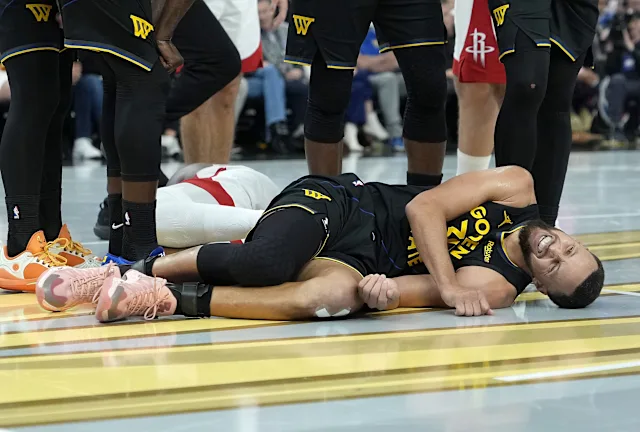
The Golden State Warriors are facing a defining moment in their season. What began as a hopeful return to contending has now shifted into a balancing act between maintaining competitiveness and addressing deeper structural issues. The latest development, Stephen Curry’s quad contusion, arrives at a time when the Warriors can least afford instability. Coupled with Jimmy Butler’s clear frustration after the team’s 10-10 start, Golden State is entering a crucial stretch that will determine whether this season evolves or unravels.
This is more than an injury update or an emotional soundbite. It is an intersection of health, performance, accountability, and identity. The Warriors are a franchise built on precision, collective rhythm, and trust. When those foundations waver, the consequences are felt instantly.
Understanding Stephen Curry’s Injury
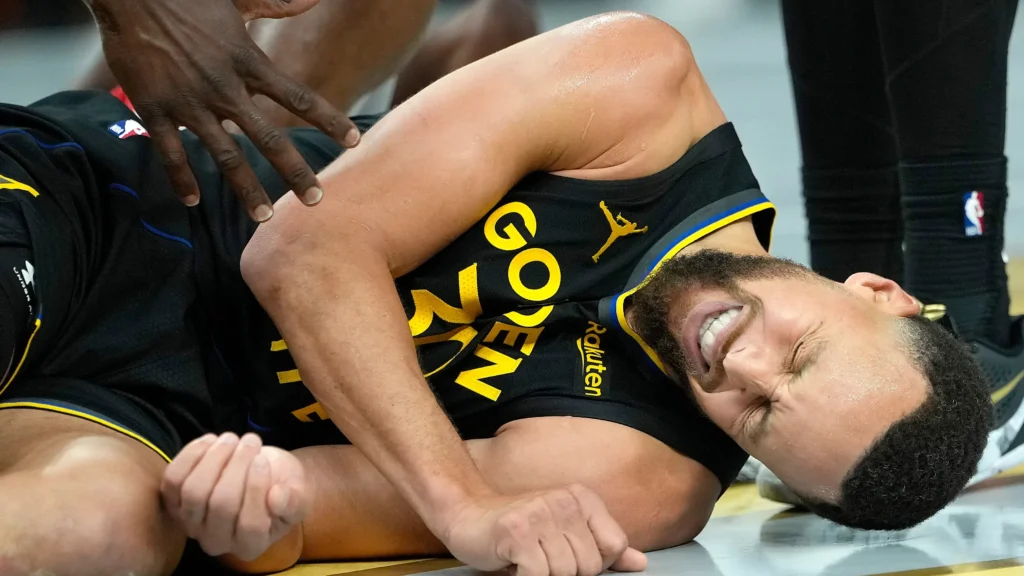
The Warriors announced that Stephen Curry will miss approximately one week, potentially slightly more after suffering a quad contusion. The severity appears mild, and MRI imaging confirmed that he avoided any significant structural damage. His return will ultimately depend on how his quadriceps muscle responds to treatment.
A quadriceps contusion is effectively a deep bruise or muscular trauma located on the front of the thigh. It occurs when a direct blow strikes the muscle, causing tissue damage, swelling, and localized pain. In Curry’s case, the injury likely occurred during a collision with Alperen Şengün in the second quarter of Golden State’s 104-100 loss to the Houston Rockets, a defeat that also eliminated the Warriors from the NBA Cup. Curry visibly limped after the play and never regained rhythm, finishing with just 14 points.
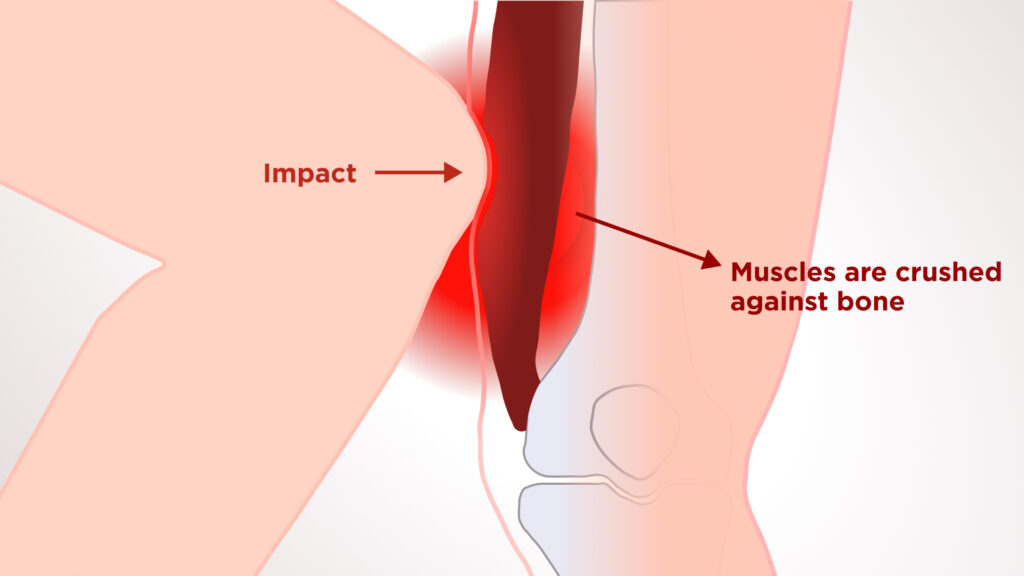
Symptoms of a quadriceps contusion can include swelling, tenderness, stiffness, bruising, or difficulty bending the knee or placing weight on the leg. Treatment traditionally follows the RICE protocol: rest, ice, compression, and elevation. Recovery timelines vary based on severity:
- A mild contusion generally heals within five to seven days.
- A moderate contusion may require several weeks.
- A severe contusion can extend beyond two months.
Curry’s diagnosis strongly suggests the mild category, but even a short absence holds significance. Curry is the foundation of Golden State’s offensive ecosystem. The absence of his spacing, initiative, and scoring gravity forces the Warriors to operate without the central mechanism around which their system is designed.
Curry’s Impact on the Warriors This Season
Stephen Curry’s numbers this season underscore his importance. He is averaging 27.9 Points per Game, 4 Assists per Game, 3.7 Rebounds per Game, 1.3 Steals per Game, and 0.6 Blocks per Game through sixteen games. He is shooting 47.1 percent from the field, 39.1 percent from three-point range, and 91.9 percent from the free-throw line.
He currently ranks 12th in the league in scoring, 51st in assists, 44th in steals, and 1st in both three-point makes and three-point attempts per game. He is averaging 4.7 made three-pointers on 12 attempts per game. His total tallies also lead the league with 75 made three-pointers and 192 attempted.
Golden State’s system is predicated on Curry’s perpetual movement, deep-range threat, and ability to bend defenses. Without him, spacing compresses, defenders collapse more readily, and ball-handlers are forced into tighter windows. The concern extends beyond scoring; Curry’s presence can dictate substitution patterns, pace, and lineup constructions. When he sits, the Warriors often lose clarity.
The Warriors have upcoming games against the New Orleans Pelicans, Oklahoma City Thunder, Philadelphia 76ers, and potentially the Cleveland Cavaliers. Given their current state, a 1-3 record or if they get lucky, maybe a 2-2 record during this period without Steph Curry.
Evaluating the Warriors’ Season So Far
Golden State’s 10-10 record places them eighth in the Western Conference. Head coach Steve Kerr summarized their situation perfectly in an interview saying: “We are an average team.” The stats reinforce this assessment.
The Warriors rank:
- Twenty-first in Points per Game (115.1)
- Twenty-second in Rebounds per Game (42.9)
- Eighth in Assists per Game (27.4)
- Third in Steals per Game (10.1)
- Eighteenth in Blocks per Game (4.5)
- Twenty-seventh in Field Goals Made (39.5)
- Twenty-fifth in Field Goals Attempted (87.1)
- Twenty-third in Field Goal Percentage (45.3 percent)
- First in Three-Point Makes (16.1)
- Second in Three-Point Attempts (44.1)
- Thirteenth in Three-Point Percentage (36.4 percent)
- Seventeenth in Free Throws Made (20.1)
- Twenty-second in Free Throws Attempted (24.4)
- Fourth in Free-Throw Percentage (82.5 percent)
- Twenty-fifth in Turnovers per Game (16.6)
Their defensive profile tells an equally balanced story. They rank 11th in fouls committed per game (20.9), effectively limiting opponents’ free-throw opportunities. Opponents average only 23.1 free throws per game, making 18.8 of them, both top ten marks defensively. The Warriors also limit opponents to 35.7 three-point attempts per game and 12.4 makes, ranking ninth and eighth respectively. Their defensive discipline on the perimeter remains one of their strengths.
However, their rebounding issues persist, and their reliance on high-volume three-point shooting leaves them vulnerable when shots do not fall. Golden State commits far too many turnovers and does not generate enough interior scoring to compensate for cold stretches.

The Supporting Cast Around Curry
Jimmy Butler remains one of the Warriors’ most productive contributors, averaging 20 Points per Game, 5.6 Rebounds per Game, 4.9 Assists per Game, and 1.7 Steals per Game. He is shooting 53.1 percent from the field, 45.9 percent from three-point range on 2.1 attempts per game (0.9 makes), and 87.1 percent from the free-throw line on 7.7 attempts (6.7 makes).
Butler’s leadership and defensive impact were expected to elevate Golden State’s competitive floor. Instead, his remarks following their tenth loss indicate a deeper frustration: “We do not box out. We do not follow the scouting report. We allow opponents to take open shots, get into the paint, and reach the free-throw line. It is disappointing.”
Jonathan Kuminga has also stepped forward after all the contract issues in the off-season, averaging 13.8 points, 6.6 rebounds, and 2.8 assists per game earning himself a two-year, 48.5 million dollar extension and a permanent spot on Steve Kerr’s starting 5.
Moses Moody and Brandin Podziemski both contribute 12.2 points per game, supporting the offense while playing within structure. Draymond Green leads the team in assists at 5.9 per game while contributing 8.4 points, 5.9 rebounds, 0.8 steals, and 0.9 blocks per game.
The supporting cast is capable. The issue is acting on it.
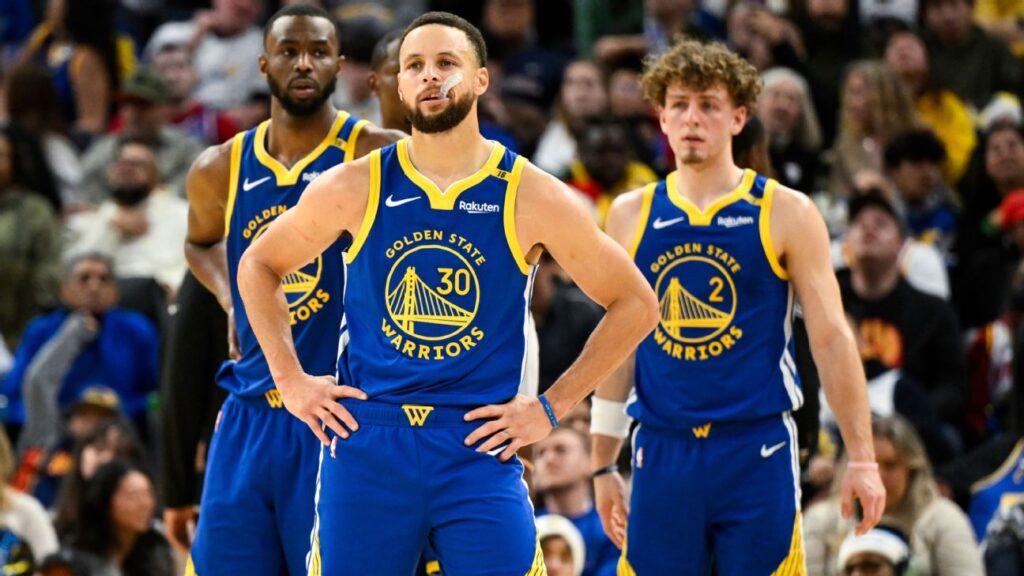
How the Warriors Can Improve
First, they must stabilize their defense. Butler’s critique reflects the most pressing issue: discipline. Golden State’s defensive identity has historically revolved around communication, anticipation, and collective engagement. Without those components, their margin for error disappears.
Second, they must reduce turnovers. At 16.6 turnovers per game, they are forfeiting possessions at a level incompatible with winning.
Third, they need more interior pressure. Excessive reliance on three-point shots makes their offense predictable. Incorporating more drives, cuts, and post activity, especially when Curry returns, will diversify their scoring.
Fourth, the rotations must tighten. Young players bring energy but also inconsistency. Strategic minutes allocation could help maintain rhythm.
Finally, they must confront accountability. Butler’s comments underscore a cultural shift. The Warriors have always thrived under high standards. Restoring those expectations could be the catalyst for turning the season around.