

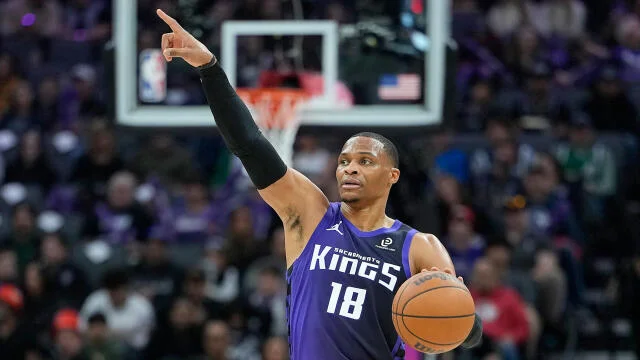
There was a time when Russell Westbrook’s legacy debates felt louder than his accomplishments. The efficiency arguments. The fit questions. The late-career scepticism. But while the noise kept changing, the production never stopped, and now the numbers are doing something undeniable.
In the span of two nights, Westbrook crossed three historic thresholds that place him in one of the most exclusive circles the NBA has ever known. On Saturday, he passed Magic Johnson on the all-time assists list and recorded his 2,000th career steal. On Sunday, he climbed past Dominique Wilkins on the all-time scoring chart.
Not in his prime.
Not as a first option.
Not with the ball dominating every possession.
But still moving up history.
A Scoring Resume That Refuses to Slow Down
Sunday night in Los Angeles wasn’t about a win. Sacramento fell 125–101. But late in the fourth quarter, Westbrook slipped into the lane and finished a routine layup, one that quietly carried historic weight.

That basket pushed Westbrook to 27,671 career points, officially moving him past Dominique Wilkins (26,668) into 16th place on the NBA’s all-time scoring list.
This matters more than it sounds.
Scoring longevity at this level is rare. Westbrook is now ahead of Hall of Famers, MVPs, and franchise icons, players whose careers were built around buckets. And he’s doing it while averaging fewer shots and fewer minutes than at any other point in his career.
Next on the list is Oscar Robertson (26,710 points), a player whose name lives permanently in NBA mythology. Westbrook has already passed him once before, with the triple-double record. Now he’s coming for him again, this time with points.
What makes this climb remarkable is not just the total, it’s the durability behind it. Westbrook has played through eras, rule changes, role shifts, and roster overhauls. The scoring never disappeared. It adapted.
Passing Magic Johnson Wasn’t Supposed to Happen, But It Did
One night earlier, Westbrook crossed a milestone that once felt untouchable.
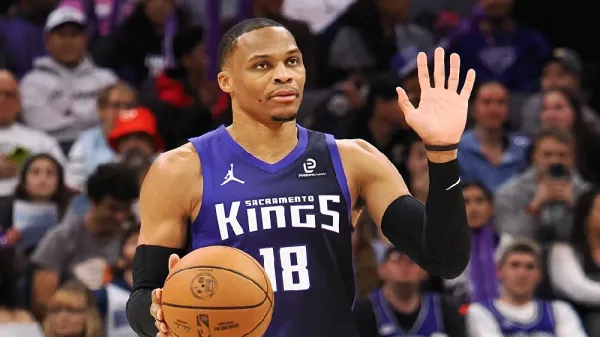
In Sacramento’s 113–107 win over Dallas on Saturday, Westbrook recorded his 10,142nd career assist, officially passing Magic Johnson for seventh place on the NBA’s all-time assists list. By the end of the night, he had 10,149 assists in 1,268 career games.
Magic Johnson finished his career with 10,141 assists in just 906 games, a testament to his brilliance and efficiency. But longevity is a skill too, and Westbrook has mastered it.
This is the part of Westbrook’s career that often gets overlooked. He has now led the NBA in assists three separate seasons (2018, 2019, 2021), adapting his game from explosive scorer to full-time engine. Few guards in league history have proven capable of both at elite levels.
And the climb may not stop here.
Westbrook sits just 185 assists behind Mark Jackson (10,334) and 186 assists behind Steve Nash (10,335). At his current pace, both could fall this season, placing Westbrook fifth all-time in assists, behind only LeBron James, Jason Kidd, Chris Paul, and John Stockton.
That is not a list built on chaos.
That is a list built on sustained excellence.
2,000 Steals: The Two-Way Piece That Completes the Puzzle
As if the scoring and passing weren’t enough, Westbrook also reached a defensive milestone that quietly reshapes his legacy.
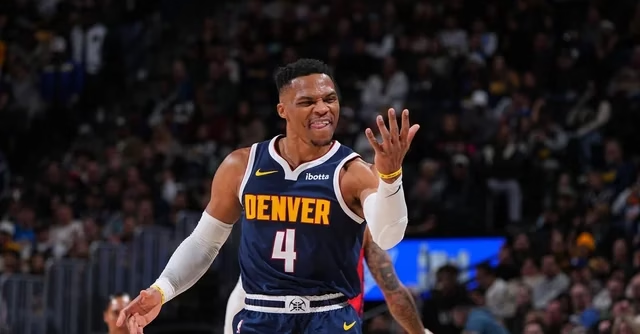
On Saturday, he became just the 14th player in NBA history to record 2,000 career steals.
That number carries weight.
Steals require anticipation, effort, and engagement, traits often lost late in careers. Yet Westbrook is averaging 1.5 steals per game through 31 games, placing him within striking distance of multiple Hall of Famers.
He is now closing in on Mookie Blaylock (2,075) and Karl Malone (2,085), with Alvin Robertson (2,112) and Hakeem Olajuwon (2,162) looming after.
This is where the résumé becomes overwhelming.
Westbrook is one of the very few players in NBA history who can realistically finish his career with 25,000+ points, 10,000+ assists, and 2,000+ steals. That combination speaks to versatility on a level few have ever reached.
What This All Means for Russell Westbrook’s Legacy
At 36, Russell Westbrook is no longer playing for validation, but history keeps validating him anyway.

Nine-time All-Star.
League MVP.
Triple-double king.
Top-20 scorer.
Top-10 passer.
Elite defensive totals.
The debates around his style may never disappear. But the record books don’t argue. They only count.
Westbrook’s career has become a case study in relentless accumulation, not empty numbers, but meaningful ones. He has reshaped what durability, versatility, and competitive longevity look like for guards in the modern NBA.
And the most remarkable part?
He’s still climbing.
Not chasing ghosts.
Not coasting on reputation.
But actively passing legends, one assist, one steal, one layup at a time.