

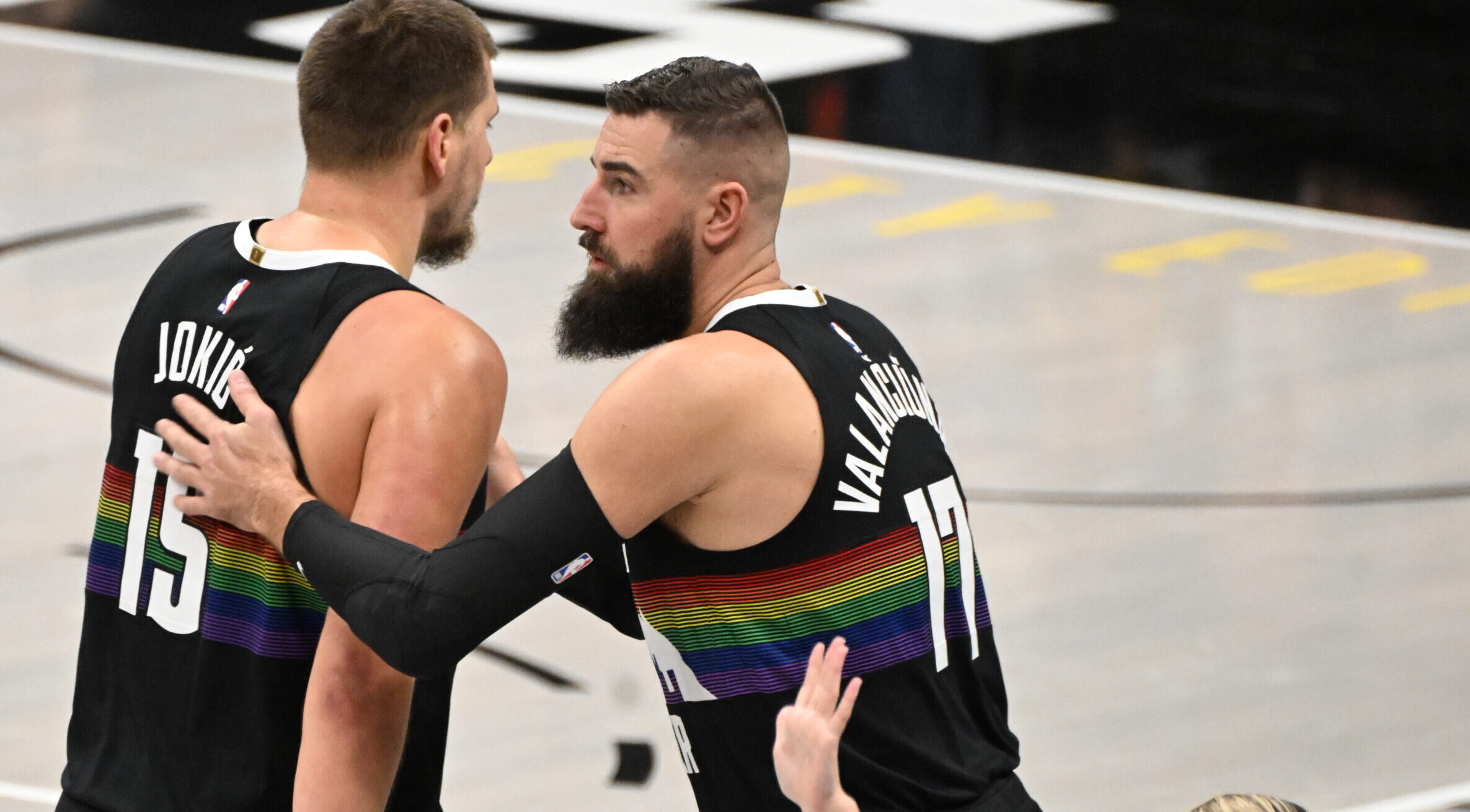
The Season Was Built on Stability, Until It Wasn’t…
For nearly a decade, the Denver Nuggets have been an anomaly in the modern NBA: stable, healthy, predictable. While contenders around them cycled through roster churn and injury chaos, Denver’s core stayed intact. Nikola Jokic played 69 or more games in every one of his first 10 seasons. Jamal Murray’s injuries were small, NOT major. The front office valued continuity over splash.
That foundation carried Denver to sustained contention, and early dominance in 2025–26.
Through 32 games, the Nuggets sat 22–10, third in the West, with the league’s top offensive rating. Jokić was in the middle of a historic campaign, averaging 29.6 points, 12.2 rebounds, and 11.0 assists, leading the NBA in assists, rebounds and triple-doubles (15), while shooting 57.7% from the field and 41.7% from three, both career highs. Denver opened the year 17–6, the best start in franchise history post-merger.
Then the foundation cracked, all at once.
Nikola Jokić’s Knee, the Injury That Changes Everything
On December 30 in Miami, Jokić hyperextended his left knee, a moment that froze the league. The relief came quickly: ligaments intact, no structural damage. The reality followed just as fast: a bone bruise and hyperextension, with a minimum four-week absence.
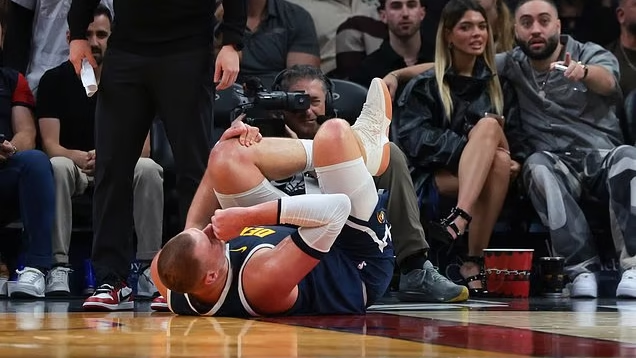
This is not a minor footnote, it’s unprecedented territory. Jokić has never missed this much time in an NBA season. If the absence stretches beyond 15 total missed games, he becomes ineligible for MVP under league rules, effectively ending one of the most statistically dominant MVP pursuits in history.
But the larger issue is structural. Denver’s offense isn’t diverse, it’s Jokic. He orchestrates possessions, stabilizes spacing, dictates tempo, and erases mistakes. With him off the floor, Denver’s offensive identity changes entirely.
And then came the next blow.
When the Injuries Compound, the Margin Disappears
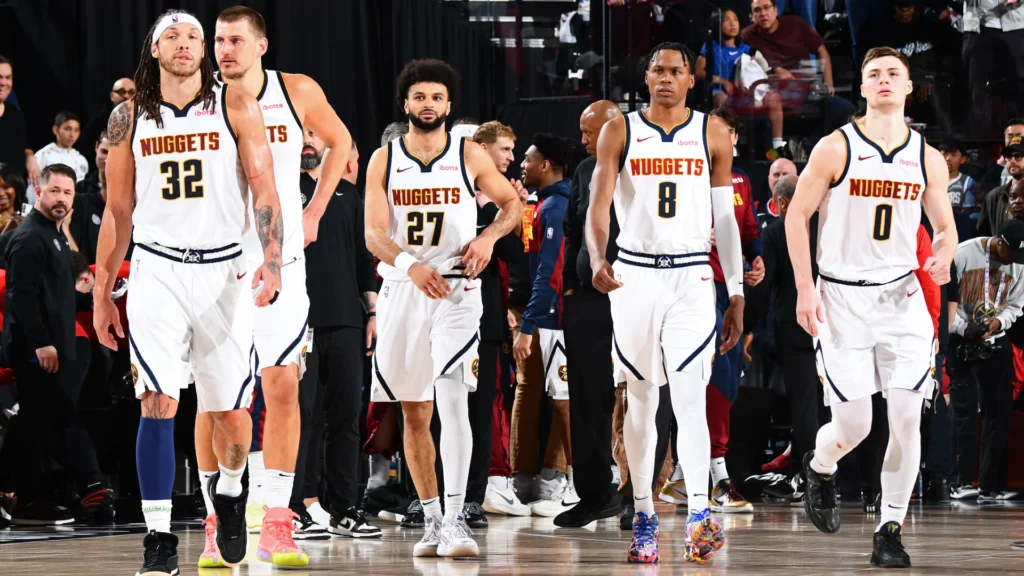
Denver didn’t just lose Jokić. They lost nearly the entire spine of their rotation.
- Aaron Gordon: Grade 2 right hamstring strain, 4–6 weeks. His absence cratered Denver’s defensive versatility and vertical pressure.
- Cam Johnson: Hyperextended right knee with a bone bruise, 4–6 weeks. A spacing starter acquired specifically to replace Michael Porter Jr.’s shooting gravity.
- Christian Braun: Left ankle sprain, 6-week re-evaluation, sidelining one of Denver’s most reliable two-way wings.
- Jonas Valanciunas: Right calf strain, 4 weeks, suffered during his first start replacing Jokic, a non-contact injury that further thinned the frontcourt.
That’s four of five starters, plus the backup center, unavailable simultaneously.
The result? Jamal Murray becomes the lone healthy starter, and the only proven creator left. Denver now relies heavily on Peyton Watson, Zeke Nnaji, DaRon Holmes II, and deep rotation players not designed for sustained starter minutes.
This isn’t depth being tested. This is depth being exhausted.
Why the Numbers Say This Could Spiral
Even with elite coaching and structure, the math is unforgiving.
Denver’s early-season defensive rating slipped from upper-tier to middle-of-the-pack once Gordon and Braun went down. Without Jokic, the Nuggets lose not only production but problem-solving. Valanciunas provided short-term relief, 8.5 points and 4.7 rebounds in just 13.3 minutes, before his calf injury removed the safety net.
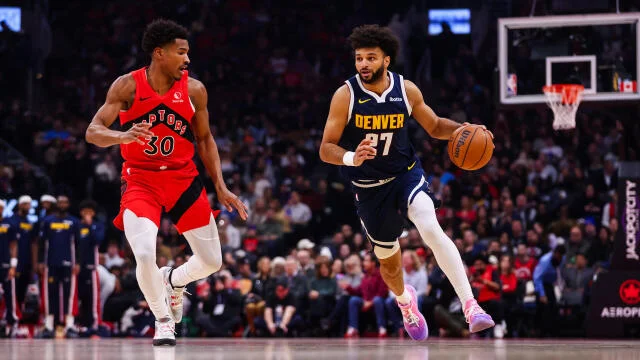
Jamal Murray has responded heroically, averaging 26.9 points and 7.5 assists over his last four games, including a 52-point eruption with 10 threes. But history shows this level of usage comes with risk. Murray is already listed as probable with a right ankle sprain, and Denver cannot afford another domino to fall.
Statistically, teams missing four starters over a 20-game stretch rarely maintain top-three seeding. Even a .500 run drops Denver into the West’s middle tier, where matchups harden and margin disappears.
And that’s before considering rhythm loss, rotations reset, chemistry fractured, and reintegration delayed.
Why Denver Isn’t Dead, Yet
Here’s the counterweight: context and ceiling.
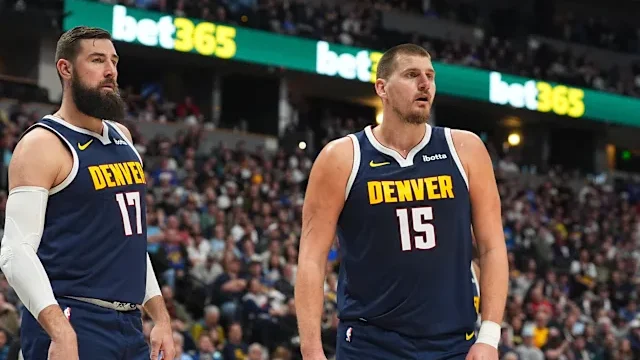
All of these injuries avoided catastrophic outcomes. No torn ligaments. No surgeries. Every starter is projected back before the postseason. Jokic’s game ages better than almost any superstar’s, less reliant on explosion, more on processing. Gordon, Braun, and Johnson fit complementary roles that reintegrate smoothly.
Denver still has:
- An elite offensive blueprint
- A championship-tested core
- A top-five player of this era returning fresh for April
If they survive the next six weeks near .500, the season isn’t cooked, it’s delayed.
But the warning is real. The Nuggets built their dynasty on health and continuity. This is the first season where both have failed them at once. And the West doesn’t wait for recovery.
This stretch will decide whether Denver enters the playoffs as a rested giant… or a wounded favorite fighting uphill.
Because when your greatest strength disappears, even temporarily, everything you assumed becomes negotiable.
Want MORE News and Highlights? Check out our YouTube Channel!