

Table of Contents
Defence in the Modern Era Starts With Amen Thompson
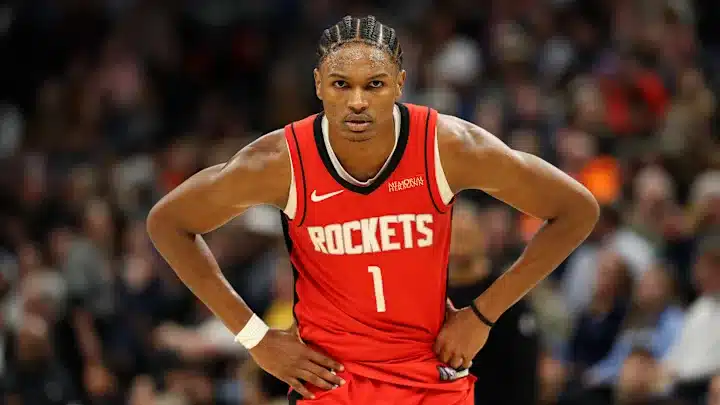
In today’s NBA, defense is no longer defined strictly by blocked shots and rim deterrence. It is defined by adaptability. The ability to switch across positions, survive in space, disrupt passing lanes, and recover in transition has become more valuable than traditional post anchoring. That is where Amen Thompson enters the conversation.
Amen Thompson has emerged as one of the most versatile defensive forces in basketball. While Defensive Player of the Year debates often revolve around rim-protecting bigs, his case is different. It is not built on towering block totals alone. It is built on flexibility, disruption, and the rare ability to guard one through five without collapsing a scheme. The question is not whether he is elite. The question is whether he is the most complete defender in the league right now.
The Case for Amen Thompson as the NBA’s Best Defender
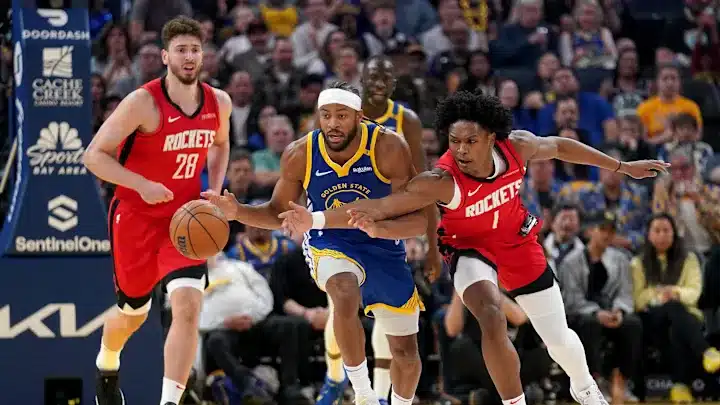
From a statistical standpoint, Thompson checks nearly every modern defensive requirement. He is averaging roughly 1.5 steals per game, 0.6 blocks, and 7.6 rebounds while playing over 37 minutes per night, a heavy workload that underscores his importance. His steal percentage (around 2.15%) ranks among the best for wings, and his discipline (2.2 fouls per game) highlights controlled aggression rather than reckless gambling. Advanced metrics reinforce the impact: a defensive rating hovering near 109 in a team context that is not elite, a consistently positive Defensive Box Plus-Minus, and strong impact metrics like CraftedPM with a notable defensive component.
Amen Thompson’s real argument, however, lies in versatility. At 6’7″ with a near 6’11” wingspan, Amen Thompson can switch onto guards, wings, and even centres in pick-and-roll actions without becoming a liability. He ranks highly in opponent isolation efficiency allowed, contests effectively at the rim when switched, and thrives in both man and help principles. Few defenders can neutralize a star guard on one possession and hold ground against a rolling big on the next. In a league built on spacing and matchups, that positional flexibility is gold.
Yet there are limitations to acknowledge. His defensive rating this season has ticked slightly upward compared to the previous year (when he posted an elite 108.1 and earned All-Defensive First Team honors), partially due to increased offensive responsibility. Greater ball-handling duties can sap defensive energy. Additionally, he does not anchor a defense the way a traditional rim protector like Victor Wembanyama or Evan Mobley can. Those players erase mistakes at the basket, a defensive value that historically weighs heavily in award voting. Thompson influences possessions everywhere, but he does not control the paint in the same structural way elite bigs do.
Impact, Awards Context, and the Modern Defensive Blueprint
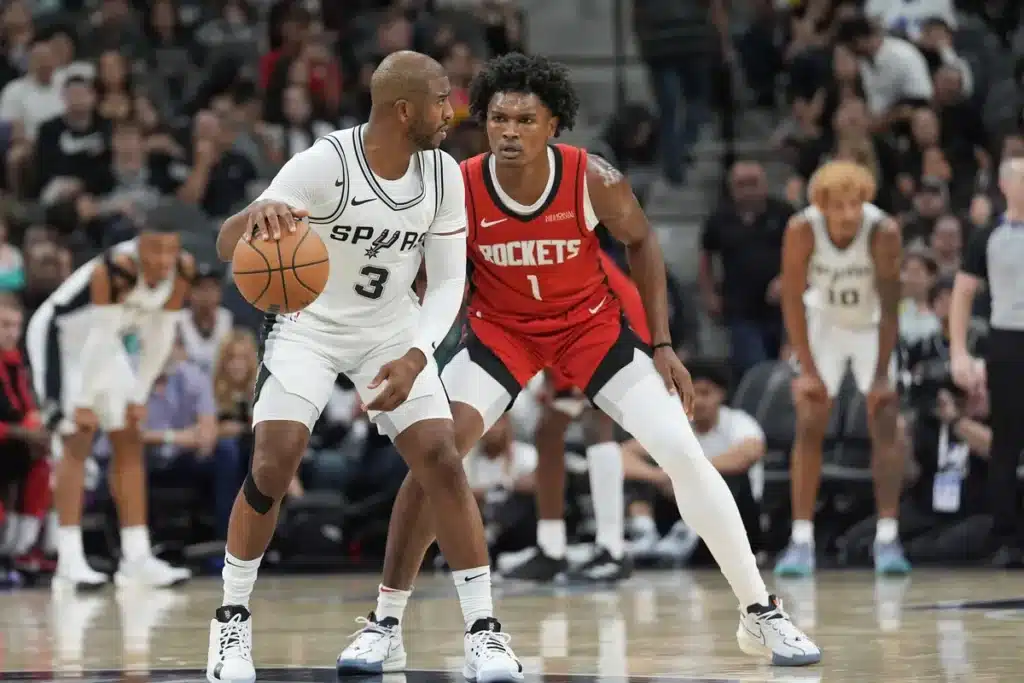
Amen Thompson’s 2024-25 campaign solidified his legitimacy. He earned All-Defensive First Team recognition and finished as high as fifth in Defensive Player of the Year voting. That was not reputation-based voting; it was production-backed. This season, despite slightly inflated team defensive numbers, he remains among the league’s most disruptive perimeter defenders. Analysts consistently label him one of the best one-on-one defenders in basketball. His ability to shut down elite scorers in isolation and generate live-ball turnovers elevates transition efficiency and swings momentum, defensive plays that convert directly into offense.
What separates him further is situational value. In late-game settings, teams hunt mismatches. Thompson erases that tactic. Switch him onto a star guard, he slides laterally and contests without fouling. Switch him onto a bigger forward, he uses length and vertical pop to challenge shots. In small-ball lineups, he can even survive against centres on short switches. That kind of elasticity allows coaches to stay aggressive defensively rather than hiding players. In a playoff series defined by matchup adjustments, that versatility is not just helpful, it is essential.
However, the broader award ecosystem still favors traditional defensive archetypes. Defensive Player of the Year historically tilts toward rim protectors because rim protection statistically correlates more directly with team defensive rating improvements. Thompson’s candidacy, often reflected in longshot betting odds (+12500 to +15000 range), illustrates the uphill battle perimeter defenders face. Additionally, because he now carries greater offensive responsibilities, sustaining peak defensive intensity over an 82-game schedule becomes more physically demanding. Durability and consistency at this usage level remain key questions moving forward.
So Is Amen Thompson The NBA’s Best Defender?
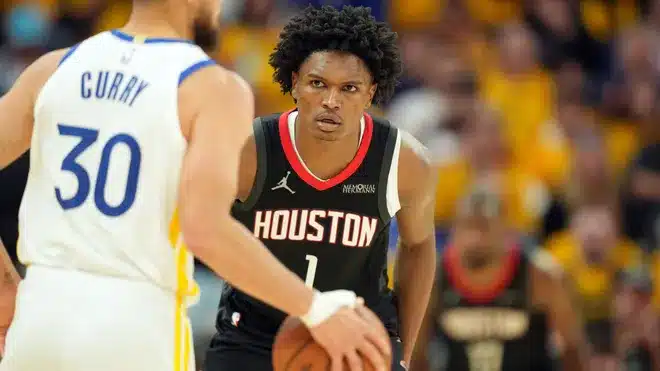
Amen Thompson may not lead every defensive metric, and he may not anchor the paint like a 7-foot rim deterrent. But defense in 2026 is about survival in space, adaptability in switches, and disruption across all five positions. In that context, his skill set is uniquely valuable.
My view is direct: he is arguably the most versatile and complete defender in the NBA today. Whether that translates into a Defensive Player of the Year trophy depends on how voters weigh versatility versus rim protection. But if the goal is to build a playoff defence capable of guarding anyone, anywhere, in any lineup, Amen Thompson is the player you choose first.
Check Out Our YouTube Channel, where we post 3 Shorts a Week and a Weekly Long Form!