

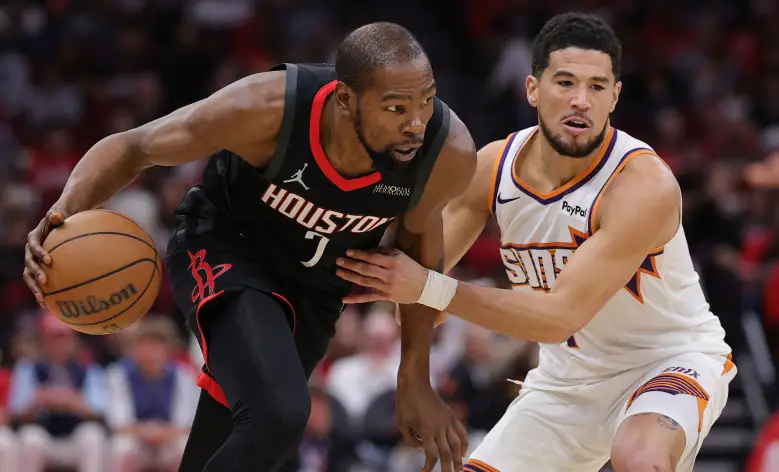
Six months later, the league has answers, and new questions.
When Kevin Durant was traded to the Houston Rockets in July 2025 as part of a historic seven-team deal, the reaction was split. Some saw it as Houston’s declaration of contention. Others viewed it as Phoenix finally admitting defeat on a failed superteam era. Now, midway through the 2025–26 season, the noise has settled, and the results are measurable.
This wasn’t a trade meant to be judged on headlines. It was meant to be judged on impact.
And so far, both sides are alive in the playoff race, but for very different reasons.
Houston’s Gamble: Star Power Meets Structure
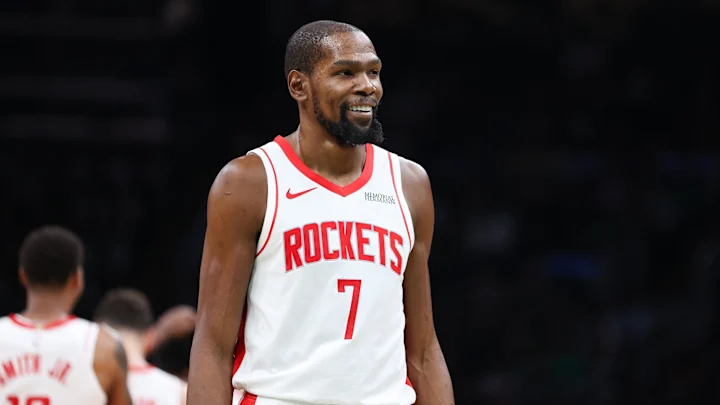
Kevin Durant has not arrived quietly.
At 26.1 PPG on 52.1% FG and 40.5% from three, Durant has been everything Houston hoped for and more. At 37 years old, he is posting one of the most efficient scoring seasons of his career, leading the Rockets in scoring while seamlessly blending into an already elite defensive framework.
Houston currently sits at 22–14, powered by balance. They rank near the top of the league defensively, and Durant’s presence has elevated their offense without breaking it. The Rockets do not rely on pace, they rely on precision, and Durant fits that identity perfectly.
What makes this work is context. Alperen Şengün is averaging 21.7 PPG, Amen Thompson thrives as a connective piece, and Durant has not been asked to carry usage-heavy chaos. He scores when needed, spaces when required, and stabilizes late-game possessions.
But it hasn’t been flawless.
Houston plays slow, ranking near the bottom in pace, and when games tighten against elite opponents, the offense can stall. Clint Capela’s addition has provided depth but not production (3.6 PPG), and injuries to guards like Fred VanVleet have exposed playmaking gaps.
Still, the Rockets look like a team that believes. And belief matters in May.
Phoenix’s Pivot: Losing a Star, Finding Direction
Phoenix’s side of the trade felt like a concession, and yet, the Suns are thriving.
At 24–15, Phoenix sits sixth in the West, far exceeding preseason expectations. This is not a contender in the traditional sense, but it is a team with momentum, flexibility, and unexpected contributors.
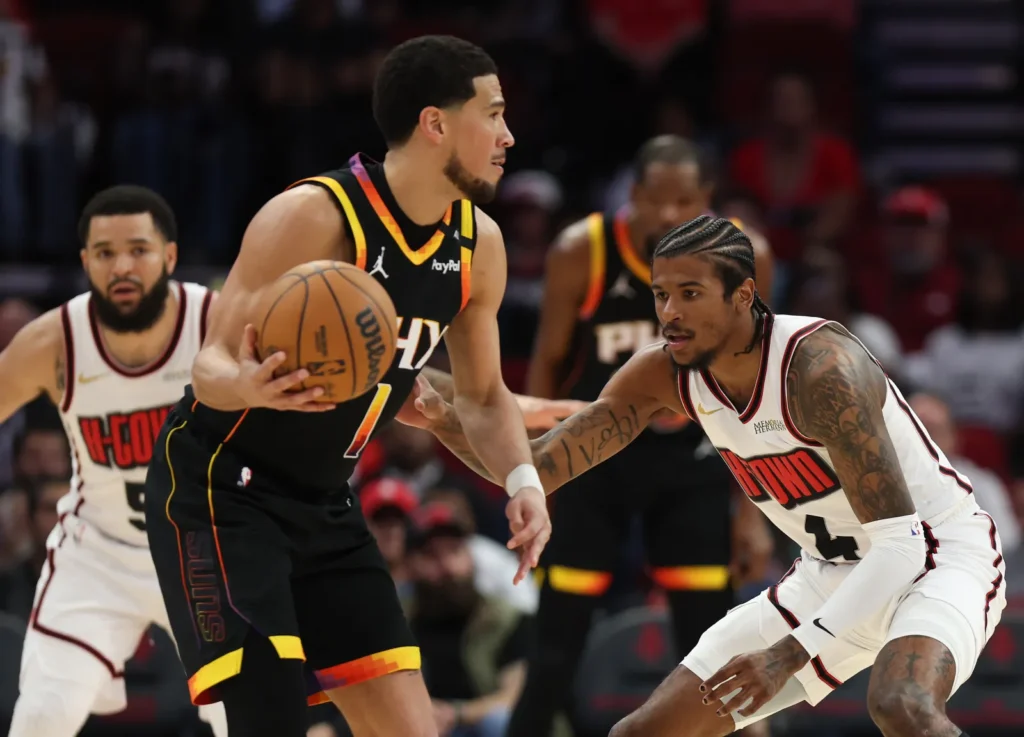
Dillon Brooks has been the surprise. Averaging 21.2 PPG on 45.6% FG, Brooks has delivered career-best scoring while maintaining his defensive edge. Devin Booker remains the engine at 25.3 PPG, anchoring an offense that wins with shot-making and resilience rather than dominance.
Jalen Green’s impact remains incomplete. Limited to just two games (15.5 PPG, 47.8% FG) before a hamstring injury sidelined him, Phoenix has yet to fully realize the offensive upside envisioned in the trade. That absence has hurt consistency and slowed the evaluation timeline.
Still, Phoenix’s identity has shifted. This is no longer a star-chasing franchise. It’s a flexible, pick-rich team with youth, cap control, and patience, something it lacked before.
The downside? Offensive inconsistency. Phoenix ranks outside the top tier offensively, and without a true alpha scorer in late-game moments, they often rely on tough shot-making rather than structural advantages.
The Verdict: Who Won?
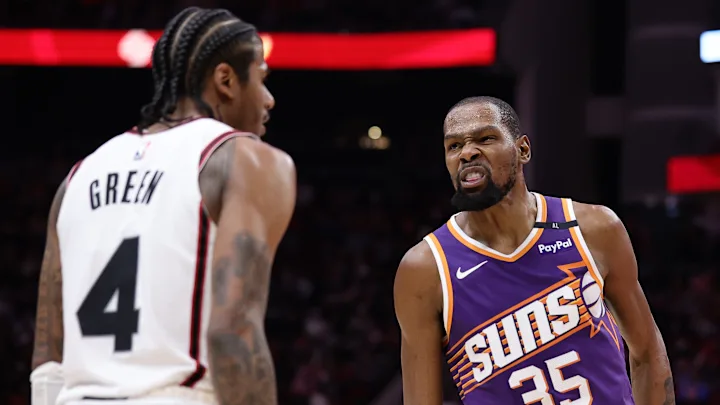
Houston made the win-now move, and it’s working. Durant’s efficiency, leadership, and adaptability have transformed a promising roster into a legitimate threat.
Phoenix made the future-proof move, and it’s stabilizing faster than expected.
Both teams are better aligned with who they are.
That’s rare.
Final Grades
Houston Rockets: A-
Elite efficiency, contender-level defense, and a superstar who fits. Minor offensive stagnation keeps it from an A.
Phoenix Suns: B+
Exceeded expectations, gained flexibility, and found contributors. Injuries and imbalance limit the ceiling, for now.
This trade didn’t create a winner.
It created two honest directions.