

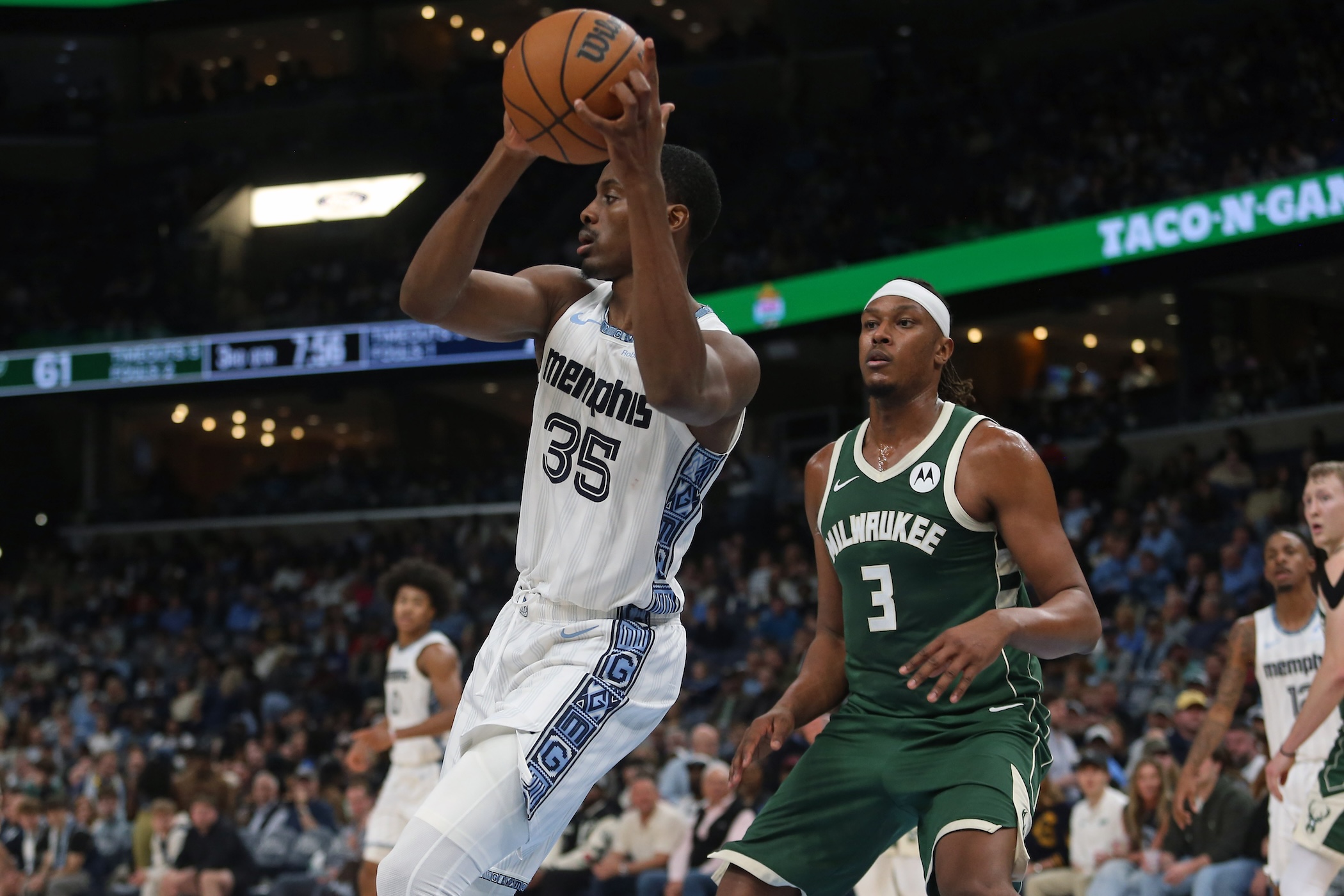
A Team Running Out of Size, and Options
Memphis did not sign Christian Koloko because of box-score production. They signed him because of context.
The Grizzlies’ frontcourt has been devastated. Rookie center Zach Edey is sidelined with an ankle injury. Brandon Clarke is out with a calf issue. Depth pieces like Vince Williams Jr. and John Konchar have also missed time, forcing Memphis to rely heavily on Jaren Jackson Jr. at the five, a role that exposes him to foul trouble, physical mismatches, and long-term wear.
In that environment, Memphis didn’t need a scorer. They needed structure. Someone who could defend the rim, rebound without scheming, and survive real NBA minutes without breaking the system.
Christian Koloko checks every one of those boxes.
Koloko’s Profile Fits the Problem, Not the Highlight Reel
Koloko, a 7-footer with a 7’5” wingspan, has always been a defense-first center. At Arizona, he was the Pac-12 Defensive Player of the Year, averaging 2.8 blocks per game while anchoring a top-tier college defense. That defensive identity carried into the NBA.
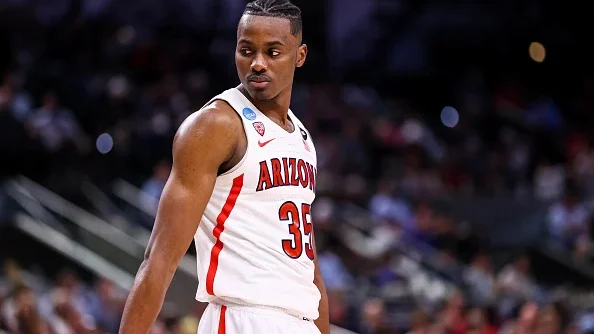
As a rookie in Toronto, Koloko averaged just 3.1 points in 13.8 minutes, but also 1.0 blocks per game, flashing elite timing and vertical deterrence. Opponents shot noticeably worse at the rim when he was on the floor, a pattern that has followed him at every stop.
His offensive limitations are real. He does not space the floor. He does not create his own shot. Nearly all of his offense comes via dunks, cuts, and lobs. But that limitation is also what makes him scalable: he doesn’t need touches to matter.
For a Memphis team already built around Ja Morant and Desmond Bane, that’s a feature, not a flaw.
The Early Memphis Numbers Quietly Pop
Through his first five games with Memphis, Koloko has averaged:
2.0 points, 3.6 rebounds, 1.0 assists, 1.2 steals, and 1.2 blocks in 18.6 minutes per game.
Those raw numbers don’t jump. The impact does.
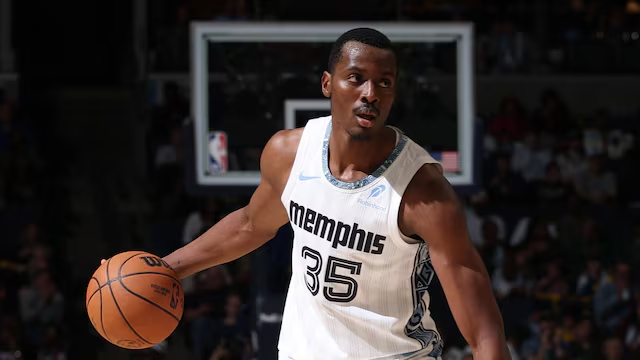
In his 93 minutes with the Grizzlies, Memphis has posted a +15.2 net rating. That’s not noise. That’s defensive stabilization. Koloko’s length changes driving angles, allows perimeter defenders to press up, and reduces the need for Jaren Jackson Jr. to cover multiple breakdowns simultaneously.
One performance in particular told the story: 4 points, 7 rebounds, 3 blocks, and a steal in 25 minutes against Washington. No play ran for him. No offensive responsibility. Just rim protection, rebounds, and discipline.
That’s the exact job description Memphis needed filled.
Why This Works Next to Jaren Jackson Jr.
Jaren Jackson Jr. is one of the league’s most versatile defenders, but he’s at his best when he can roam, not anchor every possession. Koloko allows Memphis to slide JJJ back into a hybrid role where he can weak-side contest, switch, and disrupt without absorbing constant contact.
Statistically, this pairing makes sense. Koloko’s block rate has always been strong for his minutes, and his foul discipline has improved since college. He contests vertically instead of swiping, which pairs well with Jackson’s aggression.
It also protects Memphis long-term. JJJ logging fewer emergency center minutes matters over an 82-game season, especially for a team already fighting availability issues.
Health Context Makes This a Low-Risk Bet
Koloko’s career nearly stalled due to a serious blood clot issue that cost him the entire 2023–24 season. That history understandably scared teams. But he was cleared by the NBA’s fitness-to-play panel in late 2024, logged 37 games with the Lakers in 2024–25 at 60.6% shooting, and has shown no recurring health issues since returning.
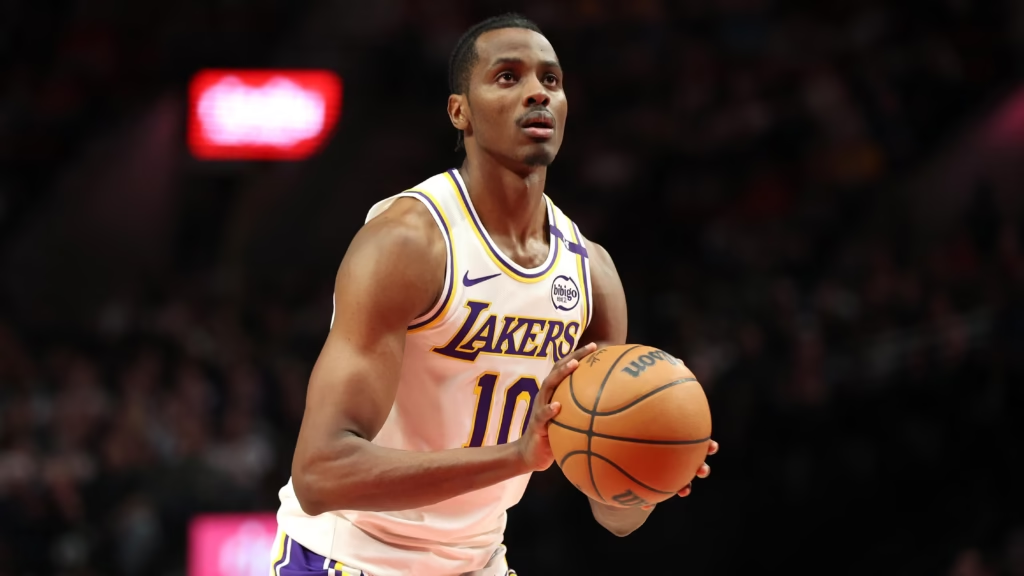
Memphis signing him via a hardship exception is a calculated move: minimal financial risk, short-term evaluation window, and the flexibility to convert him to a rest-of-season deal if injuries persist. Under NBA rules, a team can sign a player to two 10-day contracts before committing longer-term, exactly the timeline Memphis is operating on.
Given Koloko’s age (25), defensive profile, and cost, the upside far outweighs the downside.
Why This Is Smart Team-Building, Not a Desperation Move
This signing isn’t about saving the season with star power. It’s about keeping the season intact.
Memphis needed a center who could survive real minutes without collapsing spacing, fouling excessively, or demanding touches. Koloko provides rim deterrence, rebounding, and vertical spacing, all while staying within himself.
In a league obsessed with offense, these moves often get overlooked. But playoff teams are built on margins. And when injuries hit, margins are everything.
Christian Koloko doesn’t change Memphis’ ceiling.
He protects their floor.
And sometimes, that’s the difference between a season spiraling, and a season staying alive long enough for reinforcements to return.