

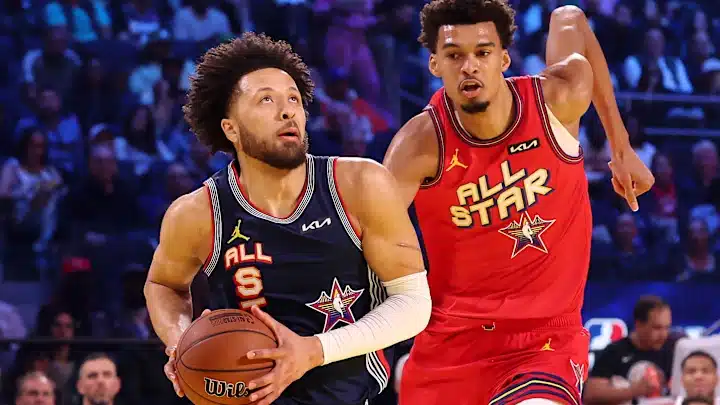
The post-All-Star stretch is typically where contenders separate and superstars tighten their MVP cases. In 2026, two names have immediately defined the league’s restart: Victor Wembanyama and Cade Cunningham. One is redefining two-way dominance at 7-foot-4. The other is orchestrating the best team in basketball with surgical offensive control. Through the first games after the break, they have been the two most impactful players in the NBA.

Victor Wembanyama: Defensive Apex, Offensive Control
Wembanyama’s surge technically began at the NBA All-Star Game in Los Angeles. Representing NBA’s Team World in the new round-robin format, he posted 33 points, 8 rebounds, and 3 blocks in just 20 total minutes across two contests. More important than the box score was the tone. He competed. He protected the rim. He treated it like real basketball. Even opposing stars acknowledged that he elevated the intensity of an event often criticized for lacking it.
Since the break, that competitive edge has translated directly to winning. San Antonio is 2-0, defeating Phoenix 121-94 and Sacramento 139-122, improving to 40-16 and second in the West. The Spurs are averaging 130 points per game post-break while allowing just 108, a +22 differential. They’re forcing 15 turnovers per game and committing only 11. That margin control is not accidental; it starts with Wembanyama anchoring both ends in the NBA.
Individually, his production underscores total-game impact. Over the two-game sample, he’s averaging 22.5 points, 13.0 rebounds, 5.0 assists, 4.5 blocks, and shooting 51.4% from the field with a staggering +27.5 average plus-minus. The stat that defines this stretch is the 4.5 blocks per game. That is defensive distortion. Opponents are altering shot profiles, avoiding the paint, and settling early.
The context matters. San Antonio is thin up front with Lindy Waters III questionable, Mason Plumlee out, and David Jones Garcia done for the season. Depth strain typically exposes rim protection vulnerabilities. Instead, Wembanyama has erased them. His presence is not just rim deterrence; it’s transition ignition. Blocks turn into runouts. Defensive rebounds turn into early offense.
Critics in the NBA argue highlights are not sustained dominance. That is fair long-term. But in this window, his impact metrics, efficiency, and team margin say otherwise. He is anchoring an elite defense while scaling offensively without sacrificing efficiency. That combination is rare. At this moment, he looks like the NBA’s most dominant two-way force.
Cade Cunningham: Offensive Command, MVP Framing
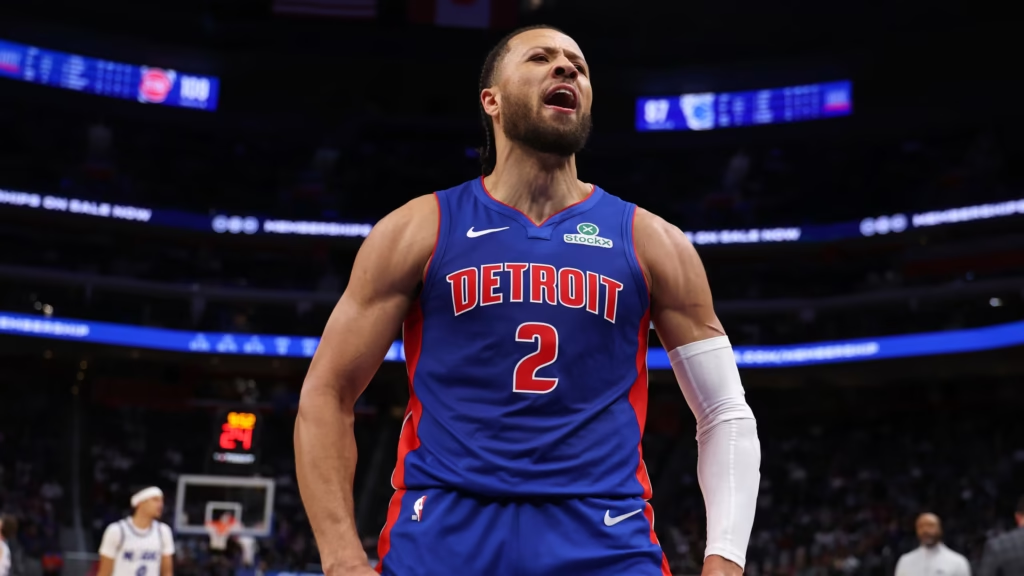
If Wembanyama is warping games defensively, Cunningham is controlling them offensively.
At All-Star Weekend, he quietly delivered 18 points, 7 rebounds, and 7 assists while helping the East secure wins. He was vocal, competitive, and composed. That leadership translated immediately when Detroit resumed play.
The Pistons defeated the Knicks 126-111, improving to 41-13, first in the East and holding the NBA’s best record entering the break. Season-wide, they own a +7.22 net rating, rank second in defensive rating, and lead the league in steals and blocks. They are 17-6 against .500+ teams. This is not schedule inflation; it’s structural dominance.
In the lone post-break game, Cunningham delivered 42 points, 8 rebounds, and 13 assists on 50% shooting with a +12 differential. His usage rate sits at 31.1%, yet the offense does not stagnate. He dictates pace, manipulates help defenders, and balances scoring with playmaking gravity. Even with Jaden Ivey out, Isaiah Stewart unavailable, and Jalen Duren just returning, Detroit has not slipped offensively.
The criticisms are predictable. His field goal percentage for the season (46%) and three-point rate (34%) are not hyper-efficient. Turnovers hover near four per game. The Eastern Conference is viewed by some as weaker at the top. Those critiques matter in MVP debates.
But control matters more. Cunningham is steering the best record in basketball while handling primary creation duties on nearly every possession. The Pistons’ structure relies on his decision-making under pressure. He is not just compiling numbers; he is engineering wins.
The Common Thread: Control of Outcome
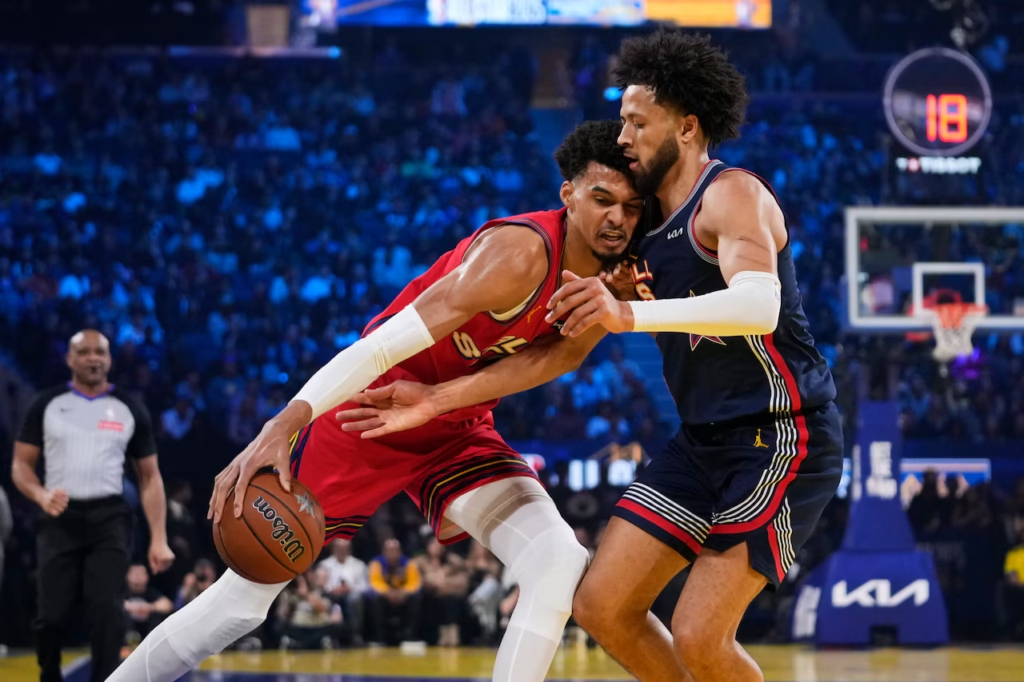
What separates both players in this immediate post-All-Star window is outcome control.
Wembanyama controls space. He dictates where opponents can and cannot score. He compresses offensive geometry and then punishes in transition.
Cunningham controls tempo. He determines when Detroit accelerates, when it grinds, and where defensive rotations collapse.
One dominates vertically. The other dominates horizontally. Both are elevating teams that are legitimately contending in their respective conferences.
Yes, the sample is small. Two games for San Antonio. One for Detroit. But momentum in the NBA often reveals trajectory before volume confirms it. Right now, no two players have reentered the season with more force.
If the post-All-Star stretch defines playoff positioning and MVP framing, the early evidence is clear: Victor Wembanyama is the league’s most terrifying defensive anchor, and Cade Cunningham is its most commanding offensive conductor.
Through this lens, they are the two best players in the NBA since the break.
Want more News, Stories and Analysis? Subscribe to Our YouTube Channel For 3 Shorts a Week and Our Bi-Weekly Podcast TheBallersPod!