

Table of Contents
In sports, there are always moments that require a certain level of discipline and courage to approach. Many players, sometimes even the great ones, can break their character. During a heated playoff moment during the 2014 Playoffs, Zach Randolph, the Memphis Grizzlies leading scorer, was having a tough time against the Thunder rookie, Steven Adams.
Adams was brutally destroying Randolph all night, notching 5 blocks against the All-Star and holding him to just 1-of-5 shooting by the second half. During a moment fueled by anger and frustration at his own terrible performance, Randolph punched Steven Adams in the jaw with a closed fist, surprisingly leading to just a common foul.
Of course, the play was later reviewed after the game by league officials and deemed an ‘unbasketball-like’ move, showcasing his poor sportsmanship for the world to see. This lack of wisdom and discipline led to Zach Randolph getting suspended for one game, which eventually led to a Game 7 loss at home for the Grizzlies, who were playing without their two best players in Zach Randolph and Mike Conley.
This is just one of many examples of professionals losing their temper at events that are entirely in their control. This may all sound a bit hypocritical. Everyone makes mistakes, everyone has off-days, and professionals are bound to have bad games. The difference between the mediocre and the legends is how they handle these spontaneous events.
All truly great players have a few things in common. For starters, they are all hard workers. As Plato, the foundational thinker of Western Stoicism, says, “Without effort, you cannot be prosperous.” From Kobe Bryant to Michael Jordan, the elite all share their embodiment of the 4 Stoic traits: Temperance, Courage, Discipline, and Wisdom.
These 4 cardinal virtues that nearly all of the ancient philosophers who studied Stoicism practiced are necessary for success in the world of basketball. As the legends of the past continue to show us, they matter even more in a world that is constantly finding new ways to aggravate and disrupt even the most controlled practitioners.
Let’s go over four examples of the four Stoic virtues in action, with four stories of legendary players and coaches who demonstrated Stoicism without even knowing it.
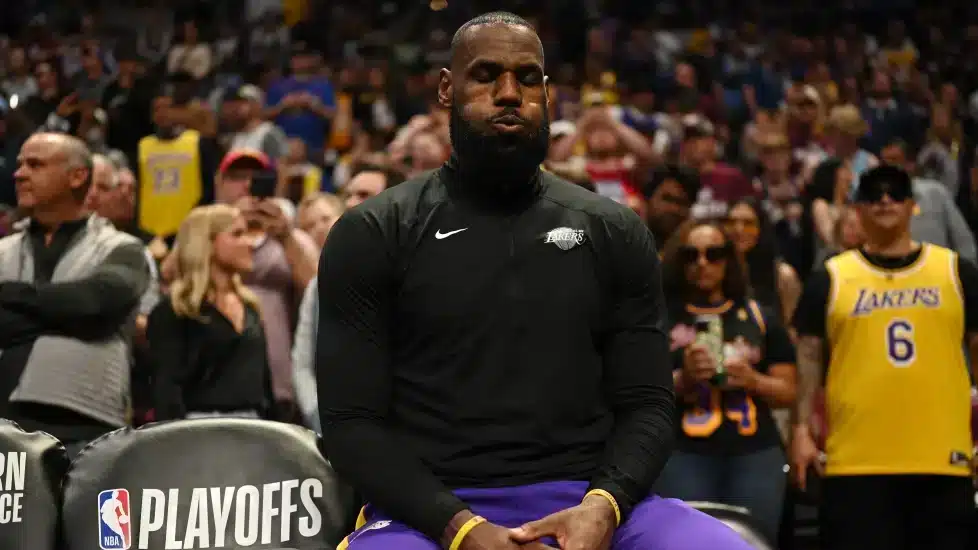
The 1st Stoic Virtue: Wisdom – LeBron James’ 2 Decisions, 10 Years Apart
When people hear that wisdom is one of the core cardinal values of the Stoic practice, many instantly think that it is some sort of abstract knowledge, such as academia and rhetoric. As explained clearly in the Stoic book Meditations by Marcus Aurelius, wisdom is more about practical judgment: knowing what the situation demands, not what the unwritten rules dictate.
During the 2014 offseason, LeBron James was coming off a devastating 4-1 NBA Finals loss to the San Antonio Spurs. LeBron’s contract with the Miami Heat expired, making him an unrestricted free agent. He was at a crossroads in his own career. The most obvious move was to remain in Miami, where success was already proven. But LeBron had the wisdom to judge that Cleveland was not only the city he made a promise to years ago, but it was also where he was most needed.
LeBron James not only delivered on his promise, winning the 2016 championship after the most impressive comeback in NBA history, beating the 73-9 Warriors after going down 3-1 in the series, he also proved that his choice was the correct one, despite the hundreds of fans and critics clowning his decision to leave Miami. Through his judgment, he displayed the clearest example of wisdom, and now he is doing it again 10 years later.
LeBron James played for the Los Angeles Lakers for more than 8 seasons. Many fans and analysts across the league, despite the rumors that were rising among insiders, assumed that he would retire on the California coast. Of course, LeBron James turned down more than 12.5x less than he would have made in Los Angeles to sign with the Philadelphia 76ers.
This decision took a level of courage to make. LeBron James went against many of his own friends, colleagues in business, and even his own agent, Rich Paul, and made the decision that made the most sense to himself. Most importantly, LeBron James had the wisdom to understand and acknowledge that in Philadelphia, he has the highest chance of winning a championship, a clear example of the 1st Stoic virtue.
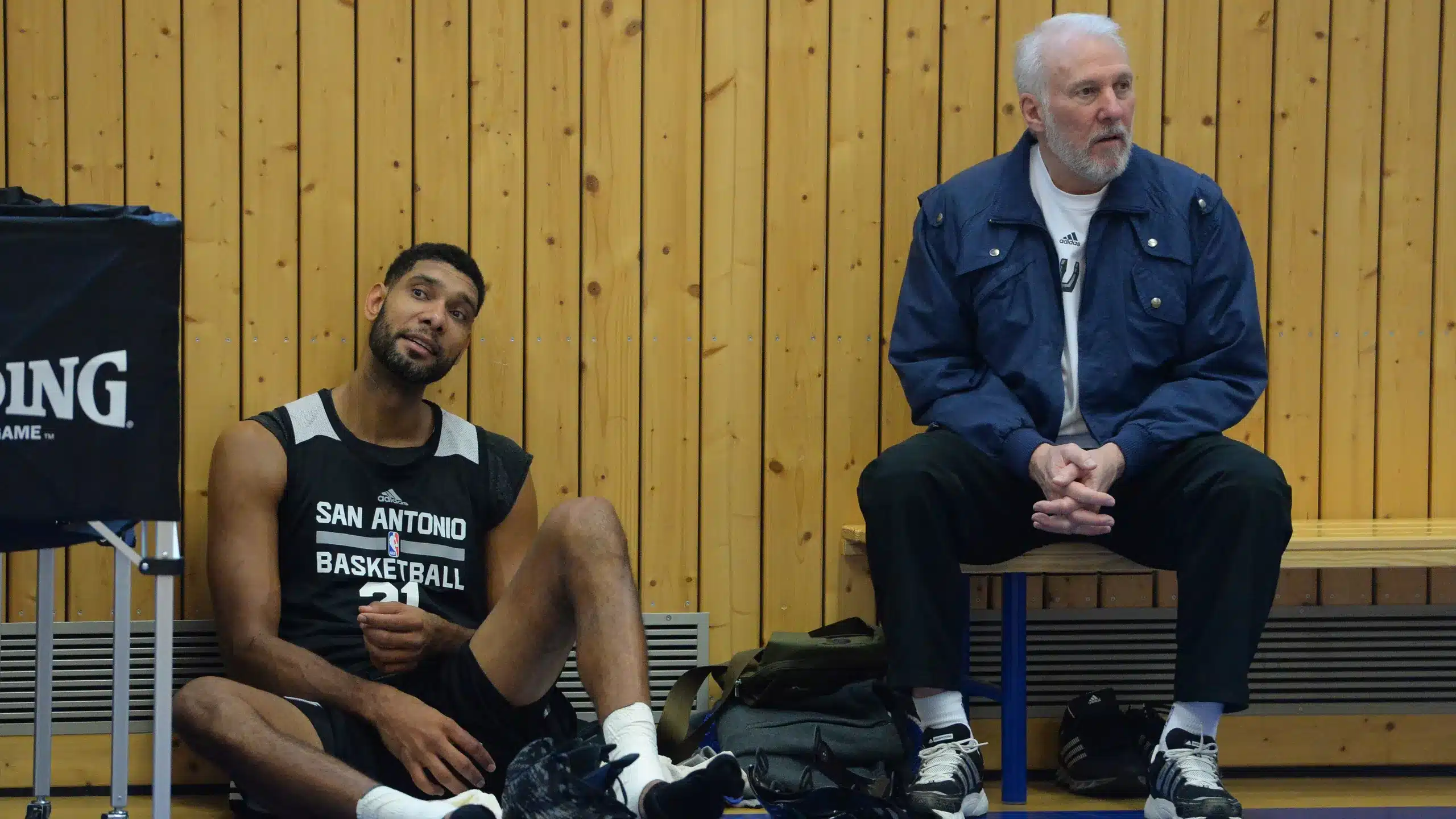
The 2nd Stoic Virtue: Courage – Tim Duncan and the Iconic “16”
In Stoicism, courage is not entirely focused on the absence of fear. It is acknowledging fear and acting rightly despite fear, loss, or humiliation. Tim Duncan is a perfect example of what it means to have courage in the face of adversity and humiliation.
During the 2013 NBA Finals, the San Antonio Spurs were swept by the Miami Heat. At 37 years old, Duncan, old and injured, had every reason to decline.
Instead, just before the 2014 Playoffs began, Tim Duncan reportedly walked directly to the front of the locker room and silently wrote the number 16 on the whiteboard: the number of wins needed to win an NBA Championship. Duncan did not shy away when faced with a new challenge; he actively embraced it.
Without going to the media and just “talking” about accomplishing his goal of another NBA championship, Tim Duncan silently wrote “16” on the whiteboard.
Soon after clearing the Dallas Mavericks and the Portland Trail Blazers in the first 2 rounds of the Playoffs, the Spurs found themselves in a similar situation. Facing the Oklahoma City Thunder, San Antonio took care of business in 6 games to advance to their 6th NBA Finals appearance since their 1999 NBA title, all versus a familiar foe: the Miami Heat.
With vengeance in their heart, the Spurs bounced back after losing their first NBA Finals in franchise history, avenging their 2013 loss with a 4-1 victory over the Miami Heat. Duncan’s courage after suffering one of the lowest moments of his career was quiet. He carried the emotional weight of the previous year’s disappointments without letting it distort or affect his next move, something both Aurelius and Epictetus practiced consistently as the first Stoics.
Tim Duncan acted correctly when he suffered from a devastating loss, not letting it consume him with the “what ifs.” Put perfectly by former NBA MVP Shaquille O’Neal, “I could get a rise out of anyone, but when I went at [Tim Duncan], he’d do nothing.” Tim Duncan is a practitioner of Stoicism at heart, and this story shows us this once again.
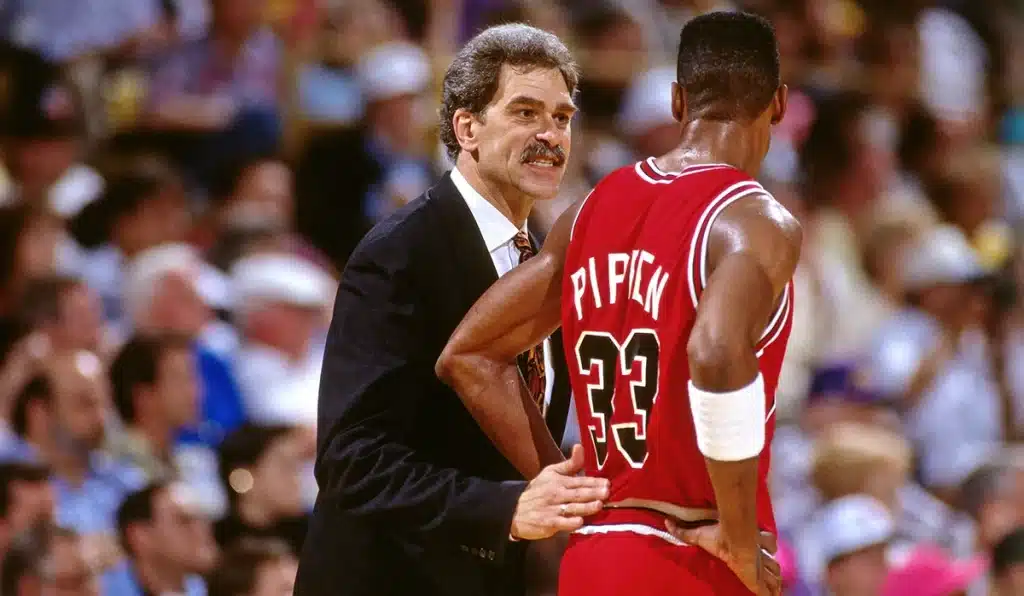
The 3rd Stoic Virtue: Justice – Phil Jackson & the Triangle Offense
The official definition of justice, according to the American Heritage Dictionary, is the principle of moral rightness or the quality of being just and fair. In Stoicism specifically, justice is giving each person their due, treating every member of the community as a part of a shared whole.
In Phil Jackson’s book, Sacred Hoops, when writing about the triangle offense, Jackson says that the strength of the formation is based on the Taoist principle of “yielding to an opponent’s force in order to render him powerless.” As Stoic Epictetus puts it: “You can’t control the outcome, but you can control your response.”
The point of the triangle offense is not for the players to create their own plays. It is to read the opponent constantly and respond in an effective way. For example, when an opponent decides to step up on defense and increase the pressure, most players would force a terrible shot or hold the ball for too long. In the triangle offense, you yield to the defense’s pressure, and in yielding, you find the open lane.
Selfishness is the path of most resistance. The selfless pass is the path of least resistance.
Most coaches would force their players into roles where they are not the most comfortable or the most effective. The truly great coaches, such as Phil Jackson, create ways to connect the team and use their players in the best possible way.
During his stint in Chicago, Phil Jackson literally gave every player on the team a piece of paper that had a 3-ring bullseye drawn on it. The center, or the bullseye, represented the team itself. Jackson asked each player to physically place themselves on the diagram based on how “connected” they felt to the group.
Players who placed themselves further out on the bullseye were confessing, without being accused, that they felt that they were operating outside of the community. Phil Jackson famously used this system to understand the team’s dynamics, revealing the problems that the team had and fixing them.
Justice in the Stoic sense is treating every member of the community as if they are a part of a shared whole, which is entirely accurate in the world of all sports. There is no better example of this in action than when Phil Jackson “tricked” the world’s greatest basketball player.
When Phil Jackson arrived in Chicago in 1989, the Bulls were initially running a hierarchical offense under former head coach Doug Collins: Michael Jordan was the focal point of the team, and everyone else on the roster orbited around him. Obviously, after spending 5 years as the only option, Jordan hated the triangle because it forced him to give up the ball more often.
When interviewed years later, Bulls star Scottie Pippen claimed they originally fought his system because they didn’t believe in it. When they saw what using the system could lead them to, they all bought into it, but most importantly, Michael Jordan was on board with it.
Jackson did not tell Jordan to be selfless. He simply built a system where selfishness was just less effective. Coincidentally, Jordan’s scoring actually increased once the triangle system was in full effect because the ball found him in better positions. Jordan was also not the only player who benefited; Scottie Pippen was reinvigorated by it.
Pippen was drafted in 1987 by the Chicago Bulls with hopes that he would be similar to John Stockton, perfectly complementing Michael Jordan. Before the triangle system was implemented, Pippen averaged a mediocre 11.2 points, 4.9 rebounds, and 2.8 assists – certainly not the “love at first sight” talent Bulls General Manager Jerry Krause described Pippen as during the draft.
During the 1989-90 season, Phil Jackson came in and began to use his triangle offense, but he also made another massive addition. Jackson saw Pippen’s potential and decided to move him into a point-forward role, which required him to create for others and also create for himself.
The improvement was immediate. Pippen ended the season with career highs in every category: 16.5 points, a 14.5% increase season-on-season, 6.7 rebounds, and 5.4 assists, nearly 55% more assists than he notched during the previous season. Pippen, when reflecting on the triangle system, said that the system let him “be what I wanted to be.”
As Stoic Marcus Aurelius puts it in Meditations 6.54, “What does not benefit the hive does not benefit the bee.” Phil Jackson deemed that what benefits the team is all that matters, and any pursuit of more money, power, and fame as an unjust action does more harm to the unit than it does good.

The 4th Stoic Virtue: Temperance – Mike Conley and the Zero Technicals
Temperance, on a Stoic level, is governing desire through reasoning. This does not mean suppressing it with another emotion; it means not allowing the emotion to take over in the first place.
Mike Conley personifies “temperance” in the philosophical sense perfectly: zero technical fouls in over 1,200 games.
Despite playing in the 44th most games in NBA history and logging the 59th most minutes by a player, Mike Conley has never received a single technical foul nor ejection in over 19 seasons of playing. This simple fact is due to Mike Conley’s extreme control when it comes to controlling himself on the basketball court.
“There’s another guy in there… this ultra, ultra, ultra competitive, do anything outside of cheating – I’m trying to win this so bad. That person is itching to come out all the time. It’s fighting its way through and trying to get out as much as it can. And I’m trying to keep that person from exploding out and taking over the light of who I view myself as.“
– Mike Conley during an interview with The Ringer’s Katie Heindl
The Ringer’s Katie Heindl explains it as being the “nice guy,” but being nice and controlling your every action like your career and life depends on it is a completely different story.
The temperate person is not the one who has no desires; it’s the one who acknowledges the desire and chooses, in that very moment, not to be governed by this foreign action. After years of practice and failure, Mike Conley seems to have mastered the simple, yet abstract, art of controlling oneself.
Mike Conley was not born with this ability. He himself has said that he gets mad just as much as the next person. Just like we discussed previously, it’s about how you react to the situation.
Mike Conley has defended his honor numerous times, such as an incident in 2014 when he was called for a technical foul against the Sacramento Kings; the NBA later rescinded the technical after Conley lobbied for it.
“It’s not something that you just do and put on for four hours or five hours. It’s a constant thing.”
– Mike Conley regarding practicing temperance throughout the day.
People can see the benefits of showing temperance in your life. Conley’s teammate Donte DiVincenzo describes the effect: “[Mike Conley] can just get on the bus and sit next to you, and you feel a calming presence, you almost feel at ease.”
As said by Seneca, “the virtuous person who refuses to be provoked will be exploited by those who profit from provocation,” and Mike Conley’s temperate and calm approach to the game has made him a target for non-physical types of disrespect. While the loudest player may reap the rewards in the system, the calmest player may absorb the cost silently.
But even knowing this, Mike Conley has never changed. Many people believe that Conley just doesn’t care, but there is a clear difference between being chill and being temperate.
“Chill” usually implies a low baseline of emotions: you are calm because you do not care much. Mike Conley is the polar opposite. He cares intensely, but the calm within him is an active choice that he continues to make, time after time.
Stoicism Has Always Been Ingrained in Basketball, Even Subconsciously
Without consciously practicing or perhaps even knowing about Stoicism and philosophy, the NBA has produced many practitioners of Stoicism.
LeBron James could have stayed in Miami, potentially winning more titles than he would have if he returned to Cleveland, but instead, he judged the situation practically. He chose what was most practical and logical to him, but the facts may have changed, and with them, his answer. That is the true definition of wisdom: practical judgment that is able to adapt to your environment.
Despite Tim Duncan increasing in age and nursing injuries, he decided to act correctly in the face of fear, loss, and humiliation and write the number 16 on the whiteboard at the front of the locker room. Duncan carried the emotional weight of the previous loss without letting it distort the next situation.
Phil Jackson, instead of yielding to Michael Jordan, created a system that gave every player their due role. The triangle system made selfishness nearly ineffective, creating selfless plays as the path of the least resistance. Phil Jackson used unity and justice to formulate the greatest superteam ever assembled in basketball history.
Mike Conley has always been a competitive player, but through temperance, he was able to govern his desires through reasoning, leading to a perfectly clean slate of zero technical fouls. Conley actively chooses to remain calm and collected at all moments throughout the day, not letting “a second ago” affect “what is about to happen.”
The 1st Stoic Virtue – Wisdom: Practical Judgment That Can Adapt to Change
The 2nd Stoic Virtue – Courage: Acting Correctly Despite Fear, Loss, or Humiliation
The 3rd Stoic Virtue – Justice: Giving Each Person Their Due
The 4th Stoic Virtue – Temperance: Governing Desire Through Reasoning
If you enjoyed this new style of writing that I am doing, or if you liked the Stoicism relating to basketball, follow my journey on X, where I will be posting more philosophy and learning connecting to basketball, and how you can be a better person as a Stoic, basketball player, or writer.