

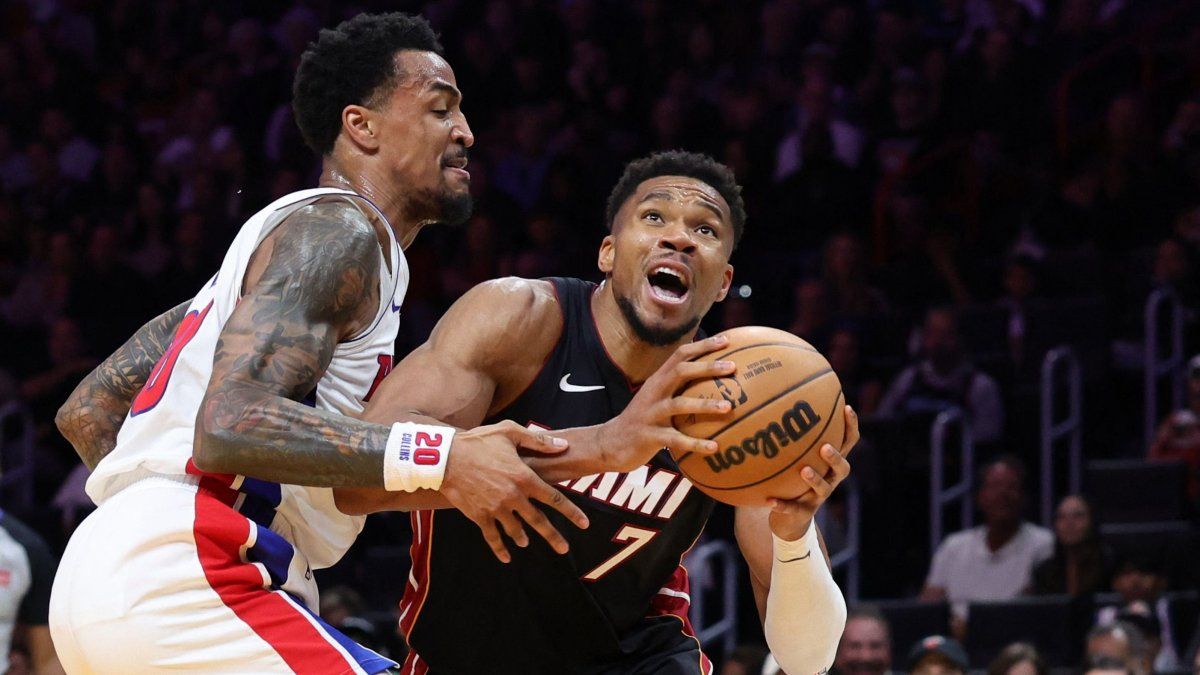
After a disastrous 0–4 start, Miami has won seven of its last nine games. Giannis Antetokounmpo and Bam Adebayo are beginning to find their chemistry, but is the Heat’s championship experiment finally working?
Check out the BallersCulture YouTube channel for a full video breakdown on our article!
Table of Contents
The Miami Heat spent years searching for another superstar. And when they finally got one, it looked like they had made a massive mistake.
After acquiring two-time MVP Giannis Antetokounmpo, Miami entered the 2026–27 NBA season with championship ambitions. They had their superstar, an elite defensive centre in Bam Adebayo, and a supporting cast that looked capable of competing with anybody in the Eastern Conference.
But instead, the Heat lost their first four games.
Suddenly, the very player they had sacrificed their future to acquire appeared to be creating more problems than he was solving.
Because there was one enormous issue with this roster: Miami’s two best players were both elite interior players, both wanted to attack the basket, and neither was particularly dangerous as a high-volume perimeter shooter.
How exactly were they supposed to coexist?
But something has changed.
Since that disastrous 0–4 start, Miami has won seven of its next nine games, including four consecutive victories. Giannis and Bam have started finding ways to operate together, Klay Thompson is providing the perimeter shooting they desperately need, and Erik Spoelstra appears to be putting the pieces together.
And after demolishing Detroit 137–117, the Heat are beginning to look like a genuinely dangerous team.
So, have Miami finally solved the Giannis problem?

The Price of a Superstar: What Miami Sacrificed for Giannis
To understand why these early-season developments matter so much, we need to go back to the summer.
Giannis Antetokounmpo was exactly the superstar Miami had spent years searching for.
A two-time MVP, NBA champion and one of the most physically dominant players in basketball history, Giannis brings almost everything you could want from a franchise cornerstone.
He’s an exceptional transition scorer, an elite interior finisher, a dominant rebounder and one of the most versatile defensive players in the league.
And Miami desperately needed that level of individual talent.
The Heat have consistently remained competitive under Erik Spoelstra, reaching multiple conference finals and two NBA Finals during the Jimmy Butler era. But they had struggled to find that final piece capable of taking them over the top.
Giannis was supposed to be that piece.
However, acquiring him came at an enormous cost.
Miami sent Milwaukee Tyler Herro, Jaime Jaquez Jr., Kel’el Ware and Kasparas Jakučionis, alongside the 13th pick in the 2026 NBA Draft, future first-round picks, a pick swap and a second-round selection.
In return, Miami received Giannis and Bobby Portis.
This wasn’t simply another superstar joining an established championship roster. It was a substantial overhaul of the organisation’s future.
And although acquiring Giannis was an incredible move, the Heat effectively committed their next era to making this partnership work.
There was just one problem.
Giannis and Bam have remarkably similar offensive tendencies.
Both are at their best attacking the basket, operating around the paint, exploiting mismatches and creating advantages through their physicality.
But basketball is a game of space.
Giannis needs driving lanes. Bam needs room to roll, cut, post up and attack smaller defenders.
When both players occupy the same areas, opposing defences can simply collapse into the paint and force Miami to beat them from the perimeter.
And neither player is naturally suited to solving that problem by consistently stretching the floor.
Miami had acquired one of the greatest players in basketball.
But had they accidentally built a roster that limited what made him so special?
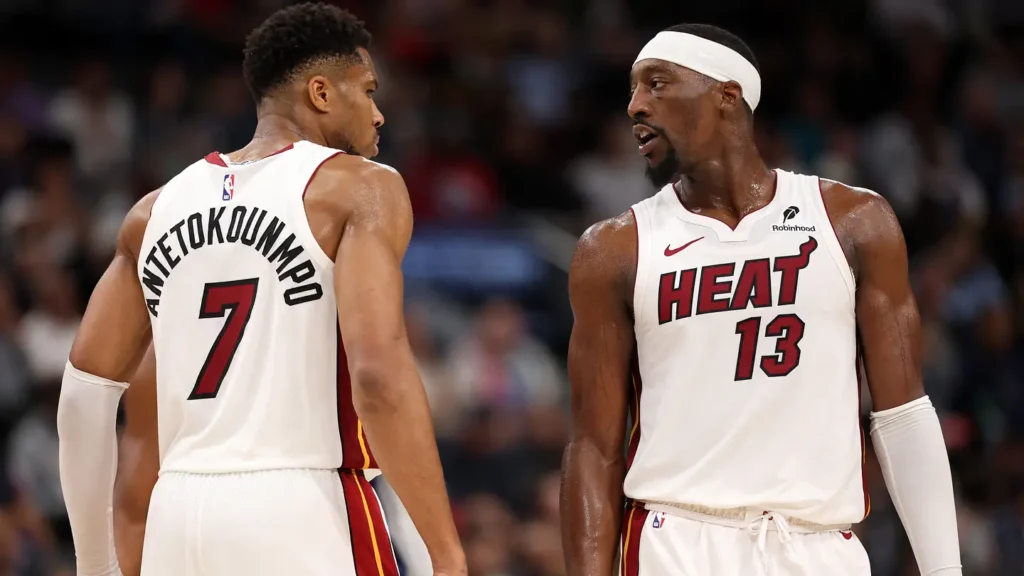
Two Magnets With the Same Polarity: The Bam–Giannis Problem
The early numbers suggested there was a genuine problem.
Miami’s offensive production with Giannis and Bam sharing the floor was far from overwhelming, and the two players were still learning how to operate around one another.
In a November 7 analysis, Giannis described their spacing as two magnets with the same polarity.
And that’s actually a brilliant way of explaining the problem.
When two magnets have the same polarity, they naturally push away from one another.
It’s a similar situation offensively.
When Giannis attacks the basket, Bam’s defender can often remain closer to the paint rather than following him away from the action.
And when Bam tries to operate inside, Giannis’ defender can help without necessarily paying a significant price.
Pelle Larsson offered another interesting description, comparing their relationship to a rubber band that needs to maintain tension.
Essentially, the two players need to remain connected without constantly occupying the same space.
When Giannis moves towards the basket, Bam needs to find another area of the floor.
When Bam receives the ball, Giannis needs to become an off-ball threat, create space or attack a different defensive responsibility.
And this is where Erik Spoelstra’s coaching becomes so important.
He cannot simply put two superstars on the floor and expect their individual talent to solve everything.
He needs to build an entirely different offensive structure around them.
And that’s precisely what Miami has started doing.
Miami’s Offensive Transformation: Finding a New Identity
One of the biggest developments during Miami’s turnaround has been its approach to offensive basketball.
The Heat have become one of the league’s most active teams in terms of ball movement and pace.
Through their first 13 games, Miami was averaging approximately 29.8 assists per game, the second-highest mark in the NBA.
And that’s particularly interesting considering how much of the team’s previous offensive identity relied on individual creation.
Instead of constantly asking Giannis to create something out of nothing, Miami is beginning to use him as the foundation of a much more connected offence.
Think about what happens when Giannis attacks the basket.
Defenders have to collapse.
The weak-side defence becomes vulnerable.
Perimeter shooters become available.
And suddenly, Giannis doesn’t necessarily need to finish the possession himself to create an advantage.
He can draw two defenders, kick the ball out and allow someone else to make the next decision.
That’s what makes him so dangerous.
His physical dominance forces defensive rotations, and Miami is beginning to capitalise on those rotations rather than simply watching him attack.
But there’s another important development.
The Heat are playing faster.
Giannis is one of the most devastating transition players in basketball.
When he gets the ball with space in front of him, there are very few defenders capable of stopping him without committing multiple players.
And Miami is beginning to take advantage of that.
Rather than allowing opposing defences to establish themselves, the Heat want to push the ball, attack early and create opportunities before the defence can get organised.
This also benefits Bam.
He doesn’t need to constantly fight for position against an established half-court defence. He can run the floor, attack mismatches and arrive in advantageous positions while defenders are still recovering.
Through 13 games, Giannis is averaging 28.9 points, 12.5 rebounds and 5.2 assists.
Those are extraordinary numbers, although relatively familiar territory for a player of his calibre.
What’s more important is how those numbers are beginning to translate into team success.
Miami is averaging 118.7 points per game, ranking among the league’s highest-scoring teams.
And the assists tell us something important.
This isn’t simply Giannis carrying another team offensively.
Miami is starting to build an offence around the advantages he creates.
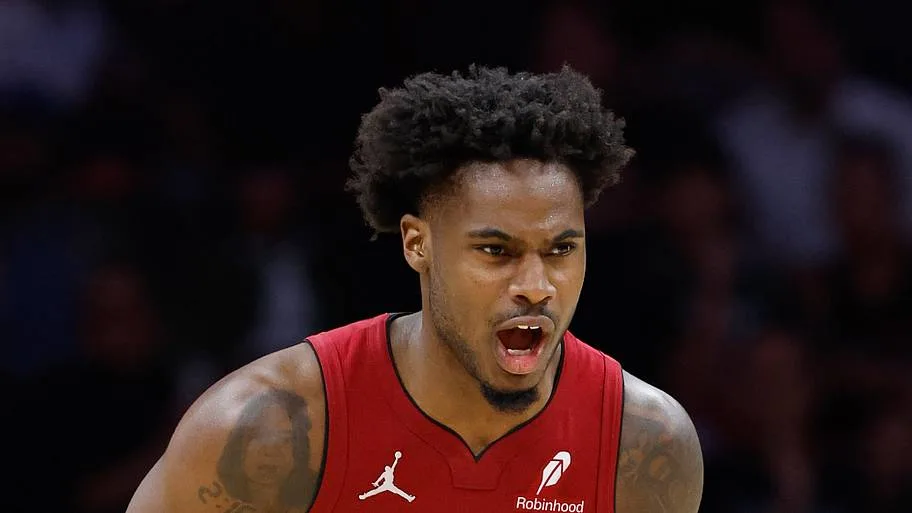
The Supporting Cast: Why Miami Needs More Than Giannis and Bam
One of the biggest mistakes people make when analysing superstar acquisitions is focusing exclusively on the superstar.
But championship basketball requires more than two exceptional players.
It requires the right supporting pieces, and Miami is beginning to discover how important those pieces can be.
Davion Mitchell: The Connector
Let’s start with Davion Mitchell.
Against Cleveland, Mitchell delivered one of the most impressive performances of his career.
He finished with 22 points and a career-high-tying 17 assists, committing just one turnover.
That’s a 17-to-1 assist-to-turnover ratio.
And Giannis was particularly impressed, highlighting Mitchell’s decision-making and the fact that he managed to distribute the ball so effectively without giving away possession.
This is exactly what Miami needs from its point guard.
Mitchell doesn’t have to score 25 points every night.
He needs to push the pace, find Giannis in transition, feed Bam in advantageous positions and consistently make the correct decisions.
He’s effectively becoming the connector between Miami’s two biggest offensive weapons.
Klay Thompson: The Missing Perimeter Threat
Then there’s Klay Thompson.
Klay’s importance to this roster is almost impossible to overstate.
When you’re playing alongside Giannis and Bam, you need players capable of punishing defensive help.
If opposing teams collapse into the paint, somebody needs to make them pay.
And Klay is one of the greatest perimeter shooters in NBA history.
After missing Miami’s Cleveland victory with an ankle injury, Thompson returned against Detroit and immediately reminded everyone what he brings to this team.
He scored 26 points, shooting 6-for-11 from three-point range.
That’s exactly the type of production Miami needs.
His presence forces defenders to respect the perimeter, which creates more opportunities for Giannis and Bam to attack inside.
Ryan Conwell: Valuable Rookie Production
And then there’s the younger supporting cast.
Ryan Conwell, the rookie out of Arizona, has already demonstrated that he can provide valuable bench production.
He scored 20 points against Cleveland, shooting 50% from the field.
His contribution is particularly important because Miami needs production beyond its starting stars.
Pelle Larsson: Another Offensive Connector
Pelle Larsson is another important piece.
His value isn’t necessarily about producing massive scoring numbers. It’s about providing another ball-handler, making intelligent decisions and connecting different parts of the offence.
These players don’t necessarily need to become stars.
They need to make the game easier for the stars Miami already has.
And that’s what we’re beginning to see.
The Heat are no longer relying exclusively on Giannis to manufacture their offence.
They’re developing a system in which multiple players can create advantages and capitalise on the attention he attracts.
The Cleveland and Detroit Statements: Proof of Concept
And if you want two games that demonstrate how much this team has changed, look no further than Cleveland and Detroit.
Cleveland: Giannis and Bam Make History
On November 13, Miami faced the Cleveland Cavaliers in an Emirates NBA Cup matchup.
And what happened was extraordinary.
Giannis Antetokounmpo scored 37 points.
Bam Adebayo also scored 37 points, adding 14 rebounds.
That’s 74 combined points from Miami’s two biggest stars.
According to the NBA’s game recap, it was only the second time in franchise history that two Heat players had scored at least 37 points in the same game.
The other occasion?
LeBron James and Dwyane Wade in 2013.
But what made this performance particularly interesting wasn’t simply the scoring.
It was how the two players were generating it.
Miami finished with 56 points in the paint, compared with Cleveland’s 40.
The Heat also received 22 points and 17 assists from Davion Mitchell, while rookie Ryan Conwell added 20 points off the bench.
This was a collective offensive performance.
And it demonstrated something important.
Giannis and Bam don’t necessarily need to take turns being the team’s best player.
They can both dominate a game when they’re allowed to attack different weaknesses in the opposition’s defence.
Detroit: The New Offensive Formula
Then came Detroit.
On November 14, Miami faced one of the Eastern Conference’s strongest teams, and the result was a convincing 137–117 victory.
Giannis finished with 34 points, 14 rebounds and eight assists, while Bam contributed another 20 points.
But the biggest storyline was Klay Thompson.
After returning from his ankle injury, he scored 26 points, making six three-pointers.
And suddenly, you could see the offensive structure Miami had been trying to build.
Giannis attacks the basket and forces the defence to collapse.
Bam exploits mismatches, contributes around the interior and provides another offensive option.
Klay stretches the floor and punishes defenders who leave him open.
These three players offer completely different offensive threats.
And that’s exactly what makes the combination so interesting.
The Heat aren’t simply trying to force Giannis and Bam to play identical roles.
They’re learning how to make their individual strengths complement one another.
And against Detroit, it worked beautifully.
Two consecutive victories against Cleveland and Detroit, 270 combined points, and a four-game winning streak.
That’s a significant change from the team that started the season 0–4.
But there’s still one enormous concern.
The Defensive Problem: Miami’s Biggest Championship Concern
And surprisingly, Miami’s biggest problem might not be the offence.
It’s the defence.
At first glance, this is a rather strange situation.
The Heat have two exceptional defensive big men.
Giannis is one of the most versatile defenders in basketball, capable of protecting the rim, switching onto smaller players and disrupting passing lanes.
Bam is an elite defensive centre, capable of defending in space, switching across positions and protecting the paint.
So why has Miami struggled defensively?
Well, the answer is more complicated than simply blaming its two stars.
Through November 7, Miami ranked 26th in defensive rating, and opponents were shooting an extraordinary 40.4% from three-point range.
But here’s where the analysis gets interesting.
Miami’s own basketball operations department highlighted that opponents were shooting significantly better than the quality of the opportunities they were generating.
The Heat had actually allowed the ninth-lowest shot quality in the league at that point.
Their opponents were converting difficult shots at an unusually high rate.
That doesn’t mean Miami’s defence was perfect.
Far from it.
The organisation identified two particularly important problems.
First, the Heat were struggling to contain penetration and track opposing cutters.
Players were getting beaten off the dribble, and once the defensive structure broke down, opponents were finding opportunities around the basket.
Second, Miami needed to improve its communication and closeouts.
Having two elite rim protectors doesn’t automatically produce an elite defence.
If perimeter defenders allow their opponents to penetrate freely, Giannis and Bam are constantly being forced to compensate for mistakes elsewhere.
And that creates problems.
One player gets drawn towards the ball, another has to rotate, and suddenly the opposition has an open shooter on the perimeter.
It’s a chain reaction.
Miami also needs to maintain its defensive rebounding.
Because even when Giannis and Bam successfully contest shots, they still need to finish possessions by securing the rebound.
This is where Spoelstra’s defensive system becomes so important.
The Heat want to protect the paint first and force opponents into contested perimeter shots.
But if those shots keep going in, or the defence fails to recover after penetration, the entire system becomes vulnerable.
The encouraging part is that Miami’s interior defensive foundation is still extremely strong.
The challenge is getting the other four players to consistently execute around it.
And until that happens, the Heat aren’t going to become a championship-calibre defensive team simply because they have Giannis and Bam.
Have the Heat Actually Solved the Giannis Problem?
So, where does this leave Miami?
Well, following the Cleveland victory, Giannis was asked whether the Heat had finally found their identity.
And his response was a reminder that the team still has plenty of work to do.
He wasn’t prepared to declare the experiment a success.
And honestly, that’s the correct mentality.
Miami has won seven of its last nine games after starting 0–4.
Giannis and Bam are beginning to demonstrate that they can coexist offensively.
Klay Thompson is providing the perimeter shooting that makes the entire system more dangerous.
Davion Mitchell is becoming an increasingly important playmaker.
And Erik Spoelstra is gradually finding the rotations and offensive structures that make this roster work.
But there are still questions.
Can Bam consistently adapt to a different offensive role?
Can Giannis become more effective without dominating every possession?
Can the perimeter shooting remain consistent?
And perhaps most importantly, can Miami develop a defence that matches its offensive potential?
These are questions that cannot be answered by four consecutive victories.
But they are certainly reasons to be optimistic.
Conclusion: The Eastern Conference Should Be Paying Attention
So, have the Miami Heat finally solved the Giannis problem?
I don’t think we’re there just yet.
The first four games of the season exposed some very real issues with this roster, and the last nine games haven’t magically eliminated them.
But something important has changed.
Miami is beginning to understand that Giannis and Bam don’t need to play the same way to be effective together.
They need to occupy different spaces, create different advantages and make opposing defences choose which problem they want to deal with.
And when you add Klay Thompson’s shooting, Davion Mitchell’s playmaking and Erik Spoelstra’s ability to build a system around elite talent, there’s a genuinely exciting team developing in Miami.
The Heat have spent years searching for another superstar.
Now they’ve finally got one.
And if they can turn these early improvements into consistent basketball over an entire season, the Eastern Conference could have a serious problem on its hands.
Maybe Miami hasn’t solved the Giannis problem just yet.
But for the first time this season, it looks like they’ve found the beginnings of an answer.
And that might be even more dangerous.