

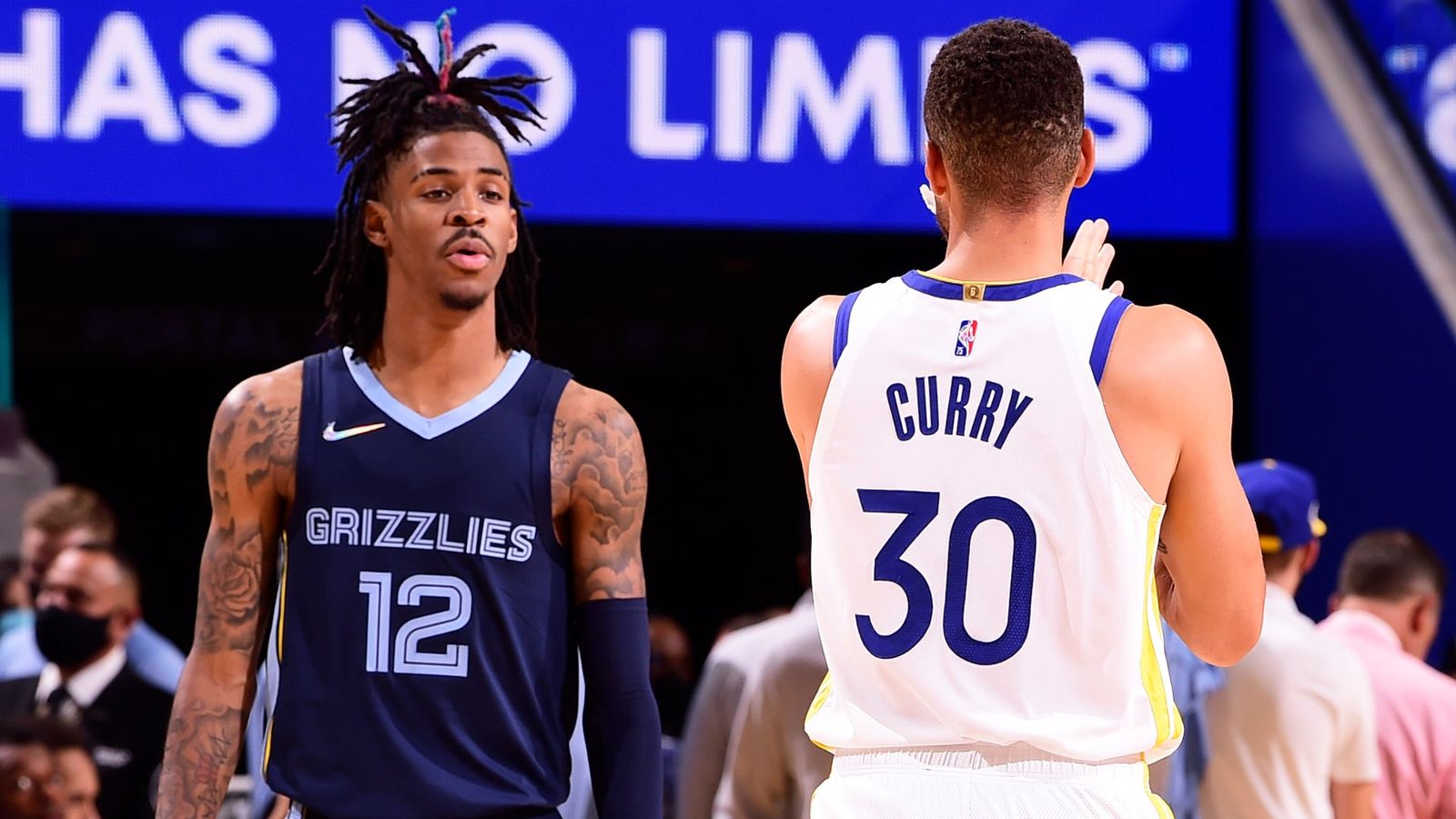
Despite the previous assumptions and speculations surrounding NBA players, they are not extraordinary in the biological sense and act within the overall laws of nature and motion, so what makes them be able to do the insane?
What if I told you that the reason why Stephen Curry shoots seemingly lights out, Ja Morant apparently can fly, and Nikola Jokic sees passes that not even the receiver of the pass can see can all be simply explained by science? All of these aren’t just coincidences either, because they are examples of the most fascinating scientific principles in action.
Table of Contents

1. Physics: The science behind impossible-looking basketball
Haven’t you always wondered why a basketball travels and glides through the air effortlessly the way it does? And how do players manipulate physics to their advantage to make these plausibly impossible shots from over 30 feet away from the basket? This can all be explained by classical mechanics and projectile motion.
Let’s use arguably the greatest shooter to ever grace a basketball, Stephen Curry from the Golden State Warriors, as a prime example of physics in basketball. Once the basketball leaves Curry’s hands, gravity is pulling the ball down because of it’s mass while the initial velocity exhorted by Curry’s hand determines the overall trajectory, or the projectile motion.
The angle at which the ball leaves his hands, or the release angle, influences it’s flight path and the entry into the basket, while the release velocity influences the general velocity, because the further away a player shoots from, the more initial velocity is generally required to achieve a similar result from closer.
And the height of the release itself also matters. The higher the release point, the less distance the ball needs to travel vertically to reach the hoop, which takes the most overall effort. Finally, the backspin. A rotation on the ball affects it’s overall interaction with the rim and backboard, making it easier for the ball to gently glide within the net or hit perfectly of the backboard.
But shooting isn’t the only place that physics is found within the game of basketball, because another player who seemingly “defies” gravity uses this to create an advantageous position for himself, and this motion requires him to jump out of the building, literally.
Ja Morant’s incredible jumping power can be simplified into three core scientific concepts. The first being Newton’s second law of motion, stating that force equals mass multiplied by acceleration. If you want to produce more force relative to your body mass, you also have to generate greater acceleration.
The second point is impulse, which is the force applied over the time spent pushing against the ground, because this determines the change in momentum, and finally, the rate of force development. Explosive athletes can generate substantial amounts of force in very short periods of time, leading to greater acceleration and subsequently, more force in the jump.
Physiology also plays an important part in the jump, and that starts with the stretch-shortening cycle. When an athlete rapidly loads their muscles and tendons before they jump, they can use all that stored elastic energy and reflex-related contributions to produce a more powerful movement.
Finally, we have Kyrie Irving. Irving is evidently a magician when it comes to rapid deceleration, stopping and changing directions, even through traffic, but a crossover isn’t just a fancy dribbling move, it is a carefully coordinated manipulation of an opponent’s balance, momentum and reaction.
Inertia states that an object in motion will resist change to it’s motion, and when Irving changes motion rapidly, a player has to use an extreme amount of force to stop moving in the direction they were, but Irving himself needs a great perception on his overall centre of mass.
Players need to manipulate their body position to maintain balance and create deceptive movements, and angular momentum and movement helps them coordinate the hips, shoulders and limbs, even through the rapid changes.

2. Neuroscience: Why NBA superstars see things ordinary people don’t
How can some of the best players in the world make decisions in literally half a second? Well, there is a difference between reaction and anticipation. A beginner might wait until a defender moves before deciding what to do, but an elite basketball player can recognise a defenders positioning, placement, eye direction and movement patterns before they even do.
This is called anticipatory perception.
In the Nature Neuroscience journal in 2008, researchers found that professional basketball players could predict shot outcomes from the free-throw line better, earlier and more accurately than coaches, sports journalists and novices, and this happened before it even left their hands.
They were reading the shooter’s body movements. The best players aren’t reacting faster, they have just seen the exact same moment play out before.
There are two core reasons why Nikola Jokic has seemingly mastered this technique. The first is pattern recognition. The brain recognises familiar arrangements of players and defensive formations, and mix that in with visual attention, where the brain prioritises relevant information, and there is no wonder why Jokic is the “smartest” player in the world.
He doesn’t need to stare directly at a teammate to understand where they are. Through repeated exposure to basketball situations, he develops an understanding of spacing, timing and movement.
The brain adapts through experience and repeated practice. As players encounter similar situations, they develop increasingly efficient ways of recognising patterns and selecting actions.
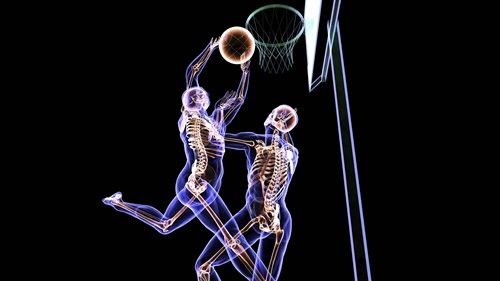
3. Human Physiology: The science behind an NBA superstar
How do NBA players actually withstand potentially thousands of minutes playing against the greatest competition in the entire world? That all has to do with physiology.
NBA players, and potentially any athlete in general, uses three main energy systems to sustain basketball ability. The first is the ATP-PC system. This is the immediate explosive energy, and doesn’t last for long, think a powerful dunk or a short sprint. The next is anaerobic glycolysis. This is reversed for higher intensity efforts, and generally lasts longer.
The final system is the aerobic system, and this sustains energy and recovery for much longer periods of time, like recovering between explosive efforts. A player might sprint down the court, jump for a rebound, accelerate into transition, and then spend the next few seconds coming back on defense as “recovery” time.
| Energy system | Main function | Basketball example |
|---|---|---|
| ATP-PC system | Immediate explosive energy | A powerful dunk or short sprint |
| Anaerobic glycolysis | High-intensity efforts lasting longer | Repeated hard defensive possessions |
| Aerobic system | Sustained energy and recovery | Recovering between explosive efforts |
Even though LeBron is an incredibly strong basketball player, his technical abilities are dismayed in the fourth quarter compared to the first quarter. Fatigue can influence his explosive power, sprint speed, jump height, coordination, decision-making and his overall shooting consistency.
A 2024 systematic review examined 44 studies on basketball match-related fatigue. It found that overall jumping and sprinting performance commonly declined during the following games, with some impairments persisting for 24-48 hours.
An NBA game isn’t just a test of who has the greatest individual ability. It’s a test of who can preserve that ability while accumulating physical and mental fatigue.
And this all leads right back to recovery. Muscle repair, glycogen replenishment, nervous system recovery, sleep and hormonal regulation, tendon and connective tissue adaptation, this is all why NBA teams make enormous investments into sports science, nutrition, strength, conditioning and even sleep management.
Check out our latest YouTube video breaking down injuries and how they could be the end of the NBA: https://www.youtube.com/watch?v=m3wTLdgpI_Y
If you enjoyed today’s blog, subscribing to our newsletter sends our latest stories straight to your inbox. One email a week, unsubscribe at anytime.
Get inside the game
Join the BallersCulture newsletter for NBA reporting, analysis and stories that go beyond the box score.