

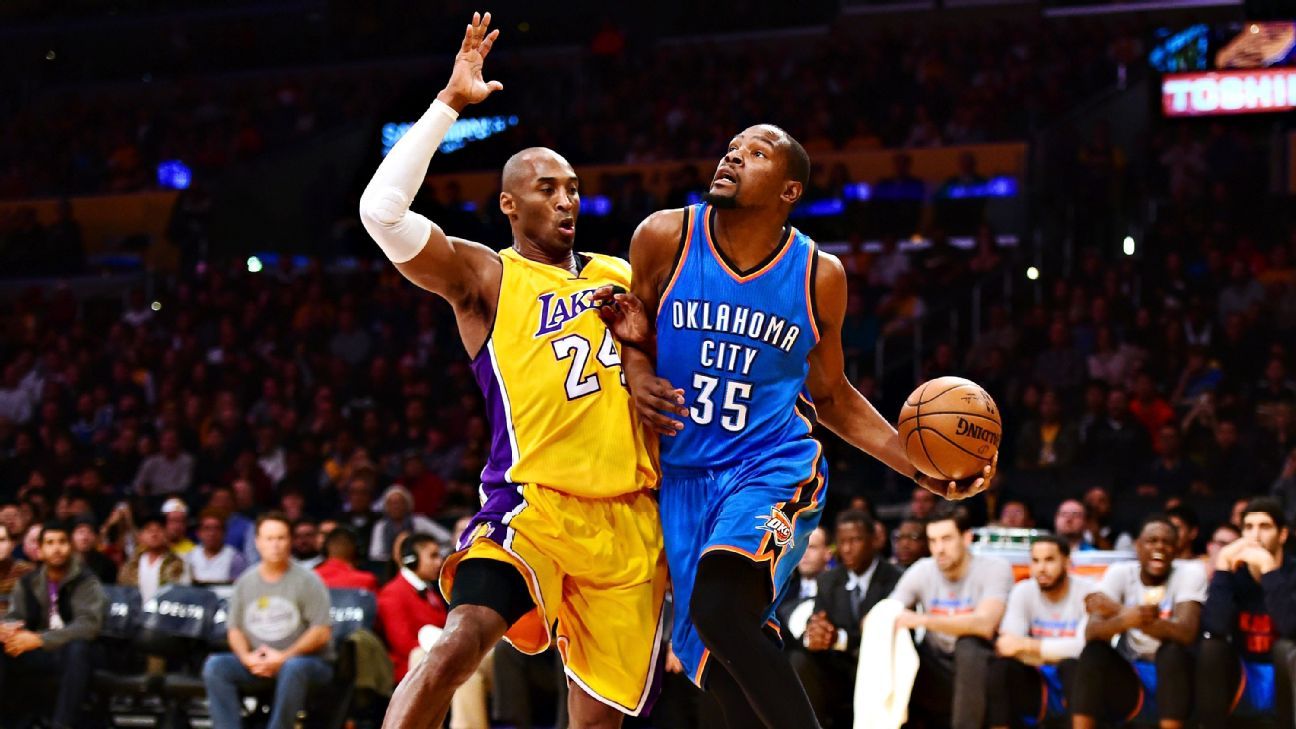
Kevin Durant has spent over 20 years doing something that almost no professional athlete could ever accomplish: still scoring at an elite level and performing regardless of his team success, the teammates surrounding him, the offensive system that’s implemented for him, or the defensive matchup in front.
But despite everything he has managed to accomplish and all of the greatness that encompasses his name, there is still one record that Kevin Durant can’t seem get get a grasp on, no matter how many seasons he has scored 20 or more in a game and regardless of his age: the NBA scoring record.
Subscribe to our YouTube Channel, where we post multiple long-form videos going over statistics, analysis, stories and more!
Table of Contents
The Making Of One Of Basketball’s Greatest Scorer
Before Kevin Durant even entered the league, he was already primed to being one of the best players in the entire world. Kevin Durant played one season (2006–07) for the Texas Longhorns, where he achieved historic success by becoming the first freshman in NCAA history to win major National Player of the Year awards.
His college accolades within his single inaugural season include:
- Consensus National Player of the Year: Unanimous selection
- Naismith College Player of the Year
- John R. Wooden Award
- Oscar Robertson Trophy
- Adolph Rupp Trophy
- AP Player of the Year
- NABC Division I Player of the Year
- USBWA National Freshman of the Year
- Sports Illustrated National Player of the Year
- Consensus First-Team All-American
- Big 12 Player of the Year and Big 12 Scoring Champion
- Big 12 Freshman of the Year and Big 12 Tournament MVP
- Big 12 All-Defensive Team and Big 12 All-Rookie Team
- National Freshman of the Year
- Texas Longhorns Jersey No. 35 was retired in his honour
After leading the NCAA men’s division in points per game and total points, averaging a mind-boggling 29 points a game as a freshman, he was selected second overall during the 2007 NBA Draft by the developing Seattle Supersonics, and was set to become their new franchise cornerstone.
During his rookie season, he quite easily managed to win the Rookie of the Year award, averaging 20.3 points, alongside a respectable 4.4 rebounds and 2.4 assists, but the development in only his second season confirmed that he as truly destined for basketball greatness.
Durant immediately improved his scoring up to 25.3 points in just his second year, and by his third season, he was truly not able to be guarded, scoring 30.1 points a night during the 2009-10 season, becoming the youngest NBA scoring champion in history at the time, aged just 21 years old.
From 2010 and 2012, Kevin Durant won three consecutive scoring titles, and after just missing out on the 2013 scoring title, he managed to win once again in the 2014 season, but he claimed another award during that same timespan. In the 2013-14 season, Kevin Durant won his first and only MVP, averaging 32 points, 7.4 rebounds, 5.5 assists and shooting 50% from the field and an incredible 40% from three.
Kevin Durant didn’t just gradually develop into an elite scorer like Kobe Bryant or Stephen Curry, by his third NBA season, he was already leading the league in scoring. He was establishing himself as one of the most productive offensive players in basketball before even being able to legally drink.
Despite being one of the greatest talents to ever grace the game, he found that he was not having the success that he wanted championship-wise with the now Oklahoma City Thunder. So after the world’s greatest duo broke up, he joined Golden State for a chance at a title. And they delivered.
After the 2016 Finals where the Golden State Warriors failed to repeat vs the Cleveland Cavaliers, they signed Kevin Durant in free agency, and the rest is history. Winning two NBA championships and two consecutive Finals MVP’s cemented his legacy as one of the best to ever do it.
During that span, he averaged 25.1 points in 2016-17, a tad more in 2017-18 getting to 26.4 points, and finally 26 points in the 2018-19 season. Durant established himself as one of the most efficient high-volume scorers in the league. Durant’s move to Golden State demonstrated that his scoring wasn’t dependent on dominating possessions.
He could operate within elite offensive systems while remaining consistent, and this matters because it shows that his scoring ability can adapt to different offensive roles and systems, not just focused on one specific team or one exact offensive system that he prefers.
The most devastating part of his career, however, isn’t the Thunder breakup, it’s when he ruptured his Achilles tendon during the 2019 NBA Finals. This was thought to be the end of his elaborate career, missing the entire 2019-20 season as a result. He returned in 2020-21 at age 32, and played just 35 games averaging 27 points.
In the very next season, he average 30 in 55 games. Durant lost an entire season of what should have been his prime. However, his scoring production after returning demonstrated that his offensive ability had survived an injury that has historically been devastating to all sorts of athletes.
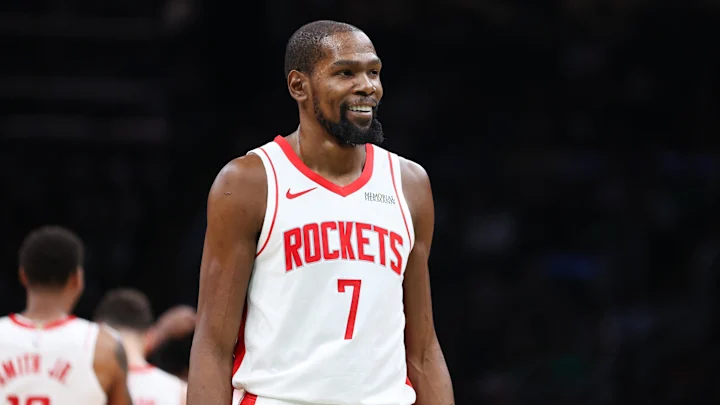
As Durant gets older, he is seemingly still defying father time and scoring at an unprecedented level. With the Phoenix Suns and Houston Rockets over the last 4 seasons, Durant has manged to score more than 26 a night every season, scoring more than 2,000 points in two of them.
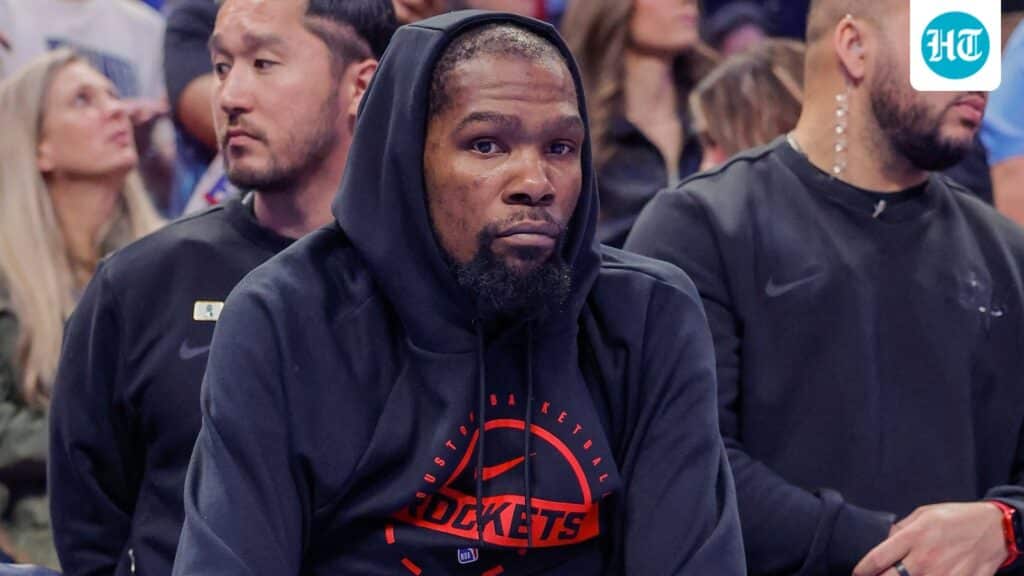
But this season could mark the end for Durant. He has played only 19 games, but he is scoring at his lowest rate since his rookie season, currently averaging 21.5 points, while still shooting 50% from the field. Is this an age-related decline, or is his adapting to a different offensive role?
Durant has already overcome an injury that could have ended his career. But recovering from an injury and accumulating another 10,000 points are two entirely different challenges.
Where Does Kevin Durant Realistically Stand In NBA History?
| Rank | Player | Points | Seasons |
|---|---|---|---|
| 1 | LeBron James | 43,697 | 24 |
| 2 | Kareem Abdul-Jabbar | 38,387 | 20 |
| 3 | Karl Malone | 36,928 | 19 |
| 4 | Kobe Bryant | 33,643 | 20 |
| 5 | Kevin Durant | 33,006 | 19 |
| 6 | Michael Jordan | 32,292 | 15 |
| 7 | Dirk Nowitzki | 31,560 | 21 |
| 8 | Wilt Chamberlain | 31,419 | 14 |
Kevin Durant, after surpassing 33,000 points, now sits as he 5th greatest scorer in NBA history. He is just about 630 points behind Kobe Bryant, 4,000 points from Karl Malone, 5,300 from Kareem Abdul-Jabbar, and over 10,000 points behind LeBron James, but the different between LeBron and the rest is that he is still playing.
Once you compare LeBron James to Kevin Durant head-to-head, you begin to understand how LeBron is so far ahead. LeBron James has accumulated 43,700 points as of today, and has played in about 400 more games than Durant, including 4 entire seasons more. Durant scores more points per gamer than LeBron, but James’ longevity proves to be unbeatable.
| Statistic | Durant | LeBron |
|---|---|---|
| Career points | 33,006 | 43,697 |
| Games played | 1,220 | 1,637 |
| Career PPG | 27.1 | 26.7 |
| NBA seasons | 20th | 24th |
| Career field-goal percentage | 50.3% | 50.6%* |
This is also one of the greatest arguments in the league, because I still believe that Kevin Durant is the greatest scorer of all time. Durant has shot 50% from the field for his career, including almost 40% from three and 88% from free throw. As a high volume shooting forward, a 55.6% effective field goal percentage is elite, especially as a career average.
Kevin Durant is a 6 foot-11 scorer who combines the shot creation of a perimeter player such as Stephen Curry or Damian Lillard, with the physical advantages of a forward like Hakeem Olajuwon or a Kevin Garnett. He can score from any spot on the floor, with his favourites being the mid range, isolation situations and the post.
| Statistic | Durant |
|---|---|
| FG% | 50.3% |
| 3P% | 39.2% |
| FT% | 88.2% |
| eFG% | 55.6% |
| Career PPG | 27.1 |
The Mathematical Challenge: What Would It Actually Take?
Mathematically, the record becomes quite literally unbreakable. LeBron James currently sits at 43,697 points as of writing this article, Kevin Durant just scored his 33,006th point. Kevin Durant would need 10,691 additional points to catch LeBron’s current total. Keep in mind that LeBron remains active, so the actual target will continue moving.
If Kevin Durant were to average 20 points a game for the rest of his career, he would still need an additional 535 games, or 6.5 entire NBA seasons to tie LeBron. At 25 points a game, he would need 428 games, but he would actually need 396 games if he could manage to score his career average of 27 points during his early and mid 40’s.
| Scoring average | Games required |
|---|---|
| 15 PPG | 713 |
| 18 PPG | 594 |
| 20 PPG | 535 |
| 21.5 PPG | 498 |
| 22 PPG | 486 |
| 25 PPG | 428 |
| 27 PPG | 396 |
| 30 PPG | 357 |
At 20 points a game, Kevin Durant would have to play 7.64 additional seasons assuming he plays 70 games or more in a year. At 27 points a game, that drops down to 5.66 seasons, which would put Durant at 26 seasons in total. The question isn’t whether Durant can score, it is whether his knees will even last another 6 years.
If he were to average 20 points on 65 games a season and about 1,300 points a season, it would take 8.22 seasons to close today’s deficit, leaving him at 46 years old. If he were to average only 15 points a night on 60 games a season, it would take him 12 years until the ripe age of 50 to complete this saga.
These are intentionally simplified projections. They don’t account for LeBron’s additional points, changing roles, missed games or retirement, but the 10,691-point deficit is not a fixed target. LeBron is still playing in his 24th season and is currently 41 years old. In November 2026, he recorded a 25-point, 12-assist, 10-rebound triple-double against Miami, proving he still has it.

The Psychology Of Kevin Durant: Does He Actually Want The Record?
Kevin Durant has said in the past that he has absolutely no intentions of chasing such an arbitrary record such as a scoring title. In a 2018 interview, Durant was asked about potentially chasing Kareem Abdul-Jabbar’s all-time scoring record. He responded with a one sentence answer.
“Because it’s not about the record.” He later elaborated on this ambiguous claim. “I can leave the game knowing I did everything I wanted to do, my way, on my terms.” I believe that these records are a strain on the game and purity of the playing style that makes it so great, and Kevin Durant understands this perfectly.
Kevin Durant is on pace to become the NBA’s second all-time leading scorer, but has still prioritised playing efficiently and winning over any record. He has a desire to control his own career rather than allow statistical milestones dictate when he retires, which is why I believe the pursuit of LeBron’s record is less important to him than just enjoying basketball.