

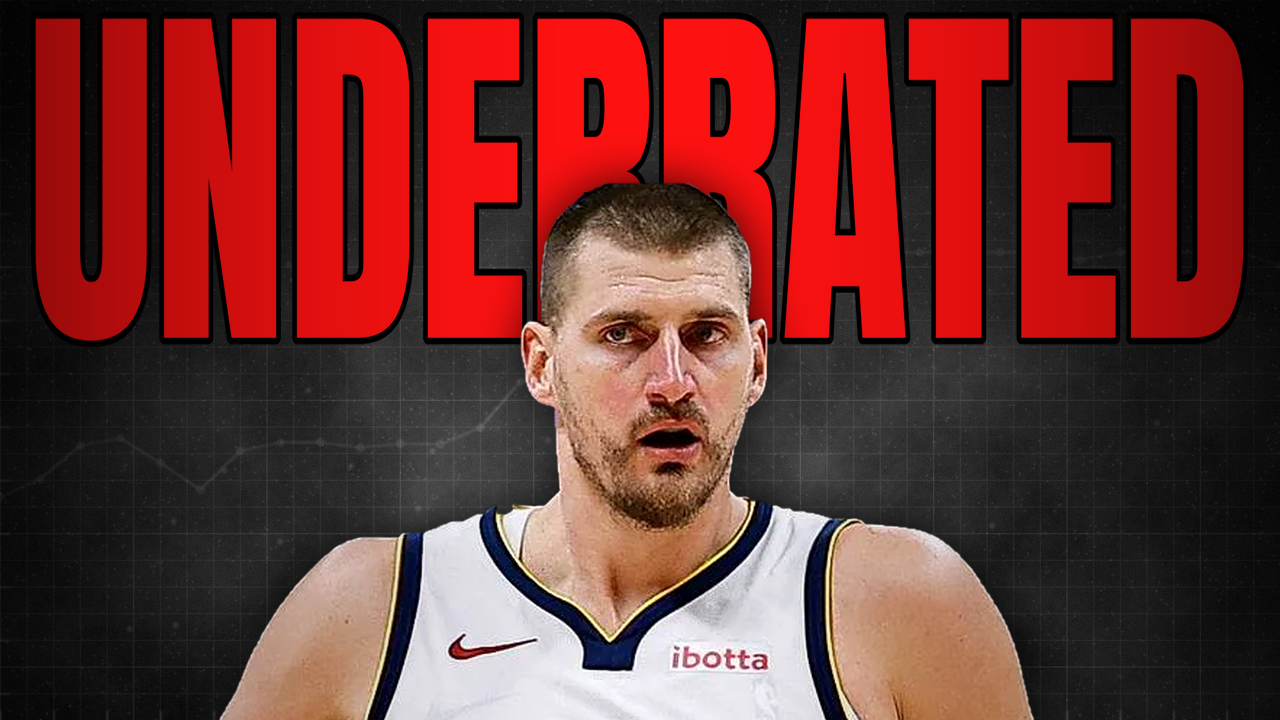
How an overlooked, overweight Serbian prospect became one of the greatest offensive players in basketball history. Watch the video on the BallersCulture YouTube Channel.
Nikola Jokić wasn’t even a top-40 pick during the 2014 NBA Draft. ESPN and the NBA had such low expectations that they were running a Taco Bell commercial during his selection. Jokić himself didn’t even have particularly high expectations, reportedly being asleep when the Denver Nuggets called his name.
Table of Contents
Scouts criticised his lack of athleticism, body type and defensive limitations. Denver initially drafted him as a long-term project, with the expectation that he would return to Europe for another season.
But despite all the criticism and against almost every expectation, Jokić went on to become arguably the greatest European-born player in NBA history.
How did he do it? Why did Denver decide to retain Jokić despite all the doubts surrounding his potential? And how did an overlooked Serbian prospect become one of the best basketball players in the world?
To understand Jokić’s rise, we need to examine his upbringing, the organisation that believed in him, the science behind his unconventional playing style, and the partnership that eventually helped Denver reach the top of the NBA.

Adolescence: The Making of an Unconventional Prospect
Nikola Jokić was born in February 1995 in Sombor, Serbia. Growing up in a basketball-oriented environment, he was exposed to the game from a very young age.
Initially, however, he wasn’t the stereotypical athletic basketball prospect. At one point, he was overweight and out of shape, lacking many of the physical characteristics traditionally associated with an elite NBA centre.
Unlike American prospects who typically develop through high-school basketball, college recruitment and nationally recognised development programmes, Jokić developed his game within Serbian professional basketball.
His development was different, and so was his playing style.
Fast-forward almost 20 years, and a young Jokić was approaching the 2014 NBA Draft, hoping to begin a new chapter in his basketball career.
Despite the doubts surrounding him, Jokić was expected to be selected. The first 15 picks came and went. No Jokić. The first round finished, and still no Jokić.
It wasn’t until the 41st pick in the second round that the Denver Nuggets finally gave him an opportunity.
ESPN, however, wasn’t even broadcasting his selection. A Taco Bell Quesarito commercial was playing when Jokić’s name appeared on screen.
Jokić wasn’t watching the draft either. After his brother called to tell him he had been selected, he reportedly didn’t initially take the news particularly seriously, assuming he would remain in Europe for another season.
But Denver had other plans.
The concerns surrounding Jokić weren’t entirely unreasonable. He didn’t possess the explosiveness expected of an NBA centre. There were questions about his physical preparation, mobility and ability to defend around the rim and on the perimeter.
His body type didn’t fit the conventional NBA prototype, and scouts weren’t certain whether his European production could translate to the highest level of basketball.
Perhaps most importantly, there was uncertainty about how to use a centre whose greatest strength was playmaking.
At the time, the NBA was increasingly valuing rim protection, vertical athleticism, switchability, explosive finishing and defensive versatility. The rise of the three-pointer and increasingly sophisticated offensive systems made those qualities particularly valuable.
Jokić didn’t fit that prototype.
But his 2014–15 season with Mega Basket provided an important piece of evidence. He averaged approximately 17 points, seven rebounds and three assists per game in around 30 minutes, across 38 appearances.
He also earned four Adriatic League Round MVP awards and was named the 2015 ABA League MVP.
Denver hadn’t simply discovered another second-round prospect. It had identified an unusual talent, although the organisation had yet to discover just how good he could become.
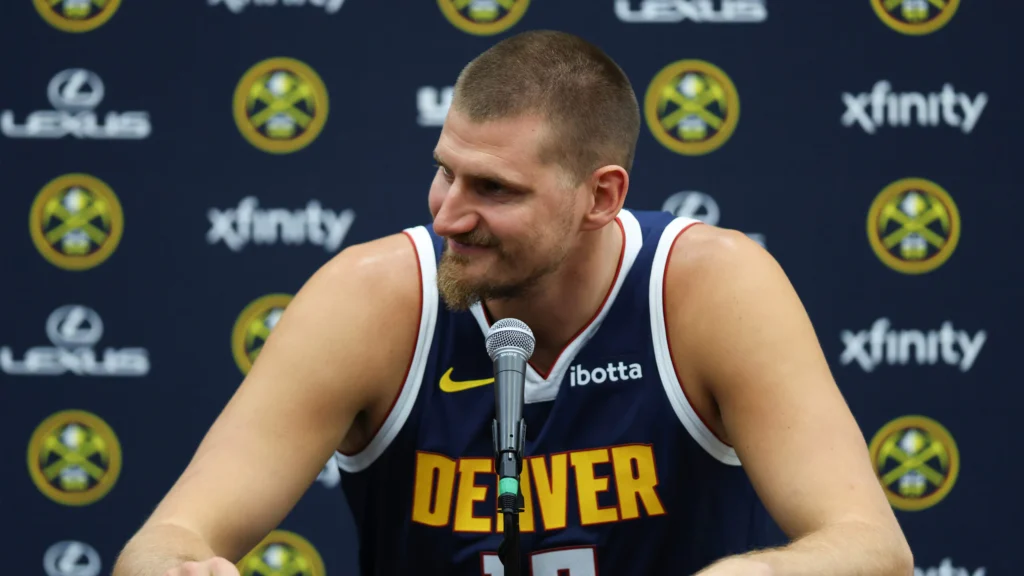
The Organisation: Why Denver Believed in Jokic
Even though the Nuggets had found an incredibly unique talent, an important question remained: what did Denver see in Jokić that 29 other teams failed to recognise?
During the draft, Jokić’s agent was reportedly prepared to withdraw his name from consideration. However, one name provided reassurance that Jokić would be selected: Tim Connelly, Denver’s president of basketball operations at the time.
The Nuggets viewed Jokić differently from many of the other teams evaluating him.
While scouts concentrated on his physical limitations, Denver recognised his elite passing ability, basketball intelligence and unusually advanced feel for the game.
They believed they could develop him into an exceptional long-term asset, viewing him as a high-upside project rather than an immediate contributor.
Jokić didn’t immediately join the Nuggets. Instead, he remained in Serbia for the 2014–15 season, allowing him to continue developing in a familiar professional environment.
On July 28, 2015, Denver officially signed him to a multiyear contract.
By retaining his NBA rights and allowing him another season of professional experience, the Nuggets gave themselves additional time to evaluate his development before bringing him to Denver at just 20 years old.
His rookie season came during 2015–16, and the early signs were encouraging.
Jokić averaged 10 points, seven rebounds and approximately 2.4 assists in less than 22 minutes per game. He appeared in 80 games, shooting 51.2% from the field and 33.3% from three-point range.
He finished third in Rookie of the Year voting, behind Karl-Anthony Towns and Kristaps Porziņģis, while finishing ahead of Devin Booker. He also earned an All-Rookie First Team selection.
Denver’s coaching staff quickly recognised that there was something unusual about his game.
Head coach Michael Malone praised his no-look passing and playmaking, even referring to him as “Magic Jokić”.
The Nuggets began to see Nikola as more than a developmental project. They started viewing him as the future of their franchise.
Jokić eventually replaced Jusuf Nurkić as Denver’s starting centre in December 2016. During that month, he averaged approximately 17 points, nine rebounds and five assists, establishing himself as the focal point of Denver’s offence.
The organisation had made its decision. Jokić was no longer simply a promising second-round pick. He was becoming the centrepiece of an entirely new offensive system.

The Science of an Unconventional Superstar
Jokić’s greatest advantage might not be physical at all. It might actually be his ability to process information.
There are several interconnected cognitive abilities that help explain why his game is so difficult to defend: peripheral vision, spatial awareness, anticipation, pattern recognition and decision-making speed.
Peripheral vision allows players to gather information from areas outside their direct line of sight. Jokić constantly uses his visual field to monitor teammates, defenders and potential passing opportunities.
Spatial awareness allows him to understand where players are positioned on the court, how much space is available and where opportunities might develop.
Anticipation allows him to predict what will happen next. Rather than simply reacting to a defender’s movement, Jokić often recognises the situation before the defender has fully committed.
Pattern recognition helps him identify recurring defensive behaviours, player tendencies and offensive movements. He can recognise familiar situations and exploit them before the opposition has time to adjust.
Finally, decision-making speed allows him to combine all this information and make an appropriate decision in fractions of a second.
These abilities are particularly important when examining why traditional scouting evaluations struggled to capture his potential.
Historically, centres were generally expected to protect the rim, rebound, set screens and finish around the basket.
Jokić expanded that job description.
He became Denver’s primary offensive organiser, a high-post playmaker, a pick-and-roll decision-maker, a post scorer, a perimeter shooting threat and a transition passer.
He wasn’t simply another centre who could pass. He was becoming the team’s primary scorer and playmaker simultaneously.
The statistical evolution demonstrates just how remarkable his development has been.
In 2017–18, Jokić averaged 18.5 points, 10.7 rebounds and 6.1 assists per game.
By 2020–21, he was averaging 26.4 points, 10.8 rebounds and 8.3 assists, winning his first MVP award.
In 2022–23, he averaged 24.5 points, 11.8 rebounds and 9.8 assists, coming close to averaging a triple-double while leading Denver to its first NBA championship.
By 2024–25, he was averaging 29.6 points, 12.7 rebounds and 10.2 assists per game.
In 2025–26, he continued producing at an extraordinary level, averaging 27.7 points, 12.9 rebounds and 10.7 assists.
The progression is remarkable. In his rookie season, Jokić averaged approximately 2.4 assists. He has since developed into one of the most productive playmaking centres basketball has ever seen.
His efficiency is equally impressive.
Player Efficiency Rating, or PER, measures a player’s per-minute statistical production while adjusting for league-wide averages. The league average is standardised at 15.
Jokić’s career PER is approximately 28.8, almost double the league average and among the highest marks in NBA history.
He scores efficiently without needing constant isolation possessions, while simultaneously generating high-quality opportunities for his teammates.
His advanced statistics further demonstrate his impact. He has recorded career figures of approximately .264 in Win Shares per 48 minutes, 7.5 in Offensive Box Plus/Minus and 10.5 in total Box Plus/Minus.
These metrics help quantify something that traditional box scores often struggle to capture: how much Jokić contributes to winning basketball beyond simply scoring points.
Defending him creates a dilemma.
Give him space, and he scores. Send help, and he creates opportunities for everyone else. Try to disrupt his positioning, and he manipulates the defence to create a different advantage.
His basketball intelligence, touch, coordination and passing ability were already exceptional, but physical development helped him sustain and maximise those abilities.
Jokić doesn’t need to jump over defenders when he can get them off balance. He doesn’t need to outrun defenders when he can manipulate their positioning. He doesn’t need to force difficult shots when he can create easier ones.
His game is built on leverage, angles, timing, coordination and decision-making.
The NBA spent years searching for increasingly athletic centres. Denver had found someone who could make five players function as one offensive system.
But individual brilliance wasn’t enough. Jokić still needed to turn that ability into something historically significant.

The NBA Couldn’t Figure Him Out: The Jokic and Murray Partnership
Almost every legendary NBA player has had an important teammate throughout their career.
Michael Jordan had Scottie Pippen. Kobe Bryant had Shaquille O’Neal. Magic Johnson had Kareem Abdul-Jabbar. LeBron James had Dwyane Wade.
For Nikola Jokić, that player is Jamal Murray.
Murray was selected seventh overall in the 2016 NBA Draft, joining Denver as another important piece of the organisation’s future.
Their development together eventually created one of the most dangerous offensive partnerships in the NBA.
Murray quickly became an important scoring option, improving from approximately 10 points per game as a rookie to more than 16 in his second season.
Jokić and Murray developed an extraordinary level of chemistry. Their ability to read each other’s movements, anticipate decisions and exploit defensive positioning made them particularly difficult to contain.
According to the supplied player-partnership statistics, Jokić and Murray have recorded a 368–211 winning record together, equivalent to a 63.6% win rate.
Their partnership reached another level during the 2020 NBA Bubble.
Denver faced the Utah Jazz in the first round of the playoffs and found itself down 3–1 in the series.
But the Nuggets refused to go home.
Behind a 30-point performance from Jokić and a dramatic comeback, Denver eventually eliminated Utah. Mike Conley’s missed 26-foot pull-up three at the buzzer sealed the series.
The very next round brought an even greater challenge: the Los Angeles Clippers.
Once again, Denver fell behind 3–1.
Once again, the Nuggets came back.
Jamal Murray produced a 40-point performance, while Jokić recorded a triple-double, helping Denver complete another historic comeback.
The Nuggets became the first team in NBA history to overcome two separate 3–1 deficits in the same postseason.
They eventually lost to the Los Angeles Lakers in the Western Conference Finals, but their playoff run demonstrated just how dangerous their offence could become.
The Jokić–Murray partnership had developed into something much bigger than two talented players sharing the court. It was an offensive relationship built on chemistry, timing and an understanding of the game that very few opponents could replicate.
And it would eventually become central to Denver’s championship ambitions.

The Greatest Underestimated Player Ever?
The player whose draft selection barely received any broadcast attention was now standing on the NBA’s biggest stage as a champion and three-time MVP.
Jokić had become a primary offensive engine capable of leading his team in scoring, rebounding and playmaking simultaneously.
But where does he stand in the all-time conversation? And is he the most underestimated player in NBA history?
His résumé is already extraordinary.
- Three-time NBA Most Valuable Player.
- NBA champion.
- NBA Finals MVP.
- Eight-time NBA All-Star.
- Six-time All-NBA First Team selection.
- Five-time Serbian Player of the Year.
His individual achievements are remarkable, but his statistical production makes his potential longevity even more interesting.
Across 823 career games in the supplied statistical profile, Jokić has averaged 22.3 points, 11.1 rebounds and 7.5 assists per game.
That already places him in exceptionally rare company.
But consider what could happen if he continues playing for another decade.
Assume he plays 65 games per season while averaging 22 points, 11 rebounds and 7.5 assists.
Over another 650 games, he would add approximately:
- 14,300 points.
- 7,150 rebounds.
- 4,875 assists.
Combined with his existing career totals, that would put him on a potential trajectory towards more than 32,000 points, 16,000 rebounds and 11,000 assists.
These are hypothetical projections, not guarantees, but they demonstrate the extraordinary statistical ceiling of his career.
In 2025–26, he averaged 27.7 points, 12.9 rebounds and 10.7 assists per game, continuing to demonstrate that his production is far from ordinary.
What makes this particularly remarkable is that Jokić isn’t dominating through the traditional physical advantages associated with elite NBA centres.
He doesn’t rely on explosive athleticism, extraordinary verticality or overwhelming speed.
Instead, his game is built around understanding basketball at a level that very few players can replicate.
There is a famous principle that one should never judge a book by its cover. Draft analysts arguably did precisely that with Jokić.
Just because he was different from the conventional prototype of an NBA centre didn’t mean he was incapable of becoming great.
The greatest players in basketball history don’t always follow established paths. Sometimes, they create entirely new ones.
If Jokić had conformed to the expectations placed upon him before the draft, who knows where he would be today?
Perhaps he would have become another conventional big man, trying to fit into a system that wasn’t designed around his strengths.
Instead, he developed a style of basketball that challenged those expectations entirely.
The Denver Nuggets didn’t just find a talented second-round pick. They found a player capable of redefining what an entire position could look like.
And perhaps that’s the most remarkable part of Nikola Jokić’s story.
The NBA didn’t know what to do with him in 2014. More than a decade later, it still hasn’t found a reliable way to stop him.
Follow BallersCulture On X For Daily Reports And News.